VAT for OnlyFans Creators: What You Need to Know to Stay Compliant in 2026
If you’re an OnlyFans creator, VAT can feel like one of those “I’ll deal with it later” topics, until a fan messages you about an extra tax charge, your payo...
If you’re an OnlyFans creator, VAT can feel like one of those “I’ll deal with it later” topics, until a fan messages you about an extra tax charge, your payouts look lower than expected, or an accountant asks for records you don’t have organized.
Here’s the good news: you don’t need to become a tax expert to stay compliant. You just need to understand (1) what VAT is, (2) when it’s your responsibility vs the platform’s, and (3) what to document so you can prove what happened if anyone asks.
Important disclaimer: This article is educational, not legal or tax advice. VAT rules vary by country and can change. Always verify with official guidance or a qualified tax professional.
VAT, income tax, and sales tax are not the same thing
Creators often use “tax” as a single bucket, but VAT works differently than income tax.
- VAT (Value Added Tax): A consumption tax added to the price paid by the customer in many countries (especially Europe). It’s typically reported and remitted through VAT returns.
- Income tax: Tax on your profit (what you earn after allowable expenses). This is usually handled in an annual return (timing depends on your country).
- Sales tax (US style): Similar idea to VAT (a consumption tax), but it’s administered differently (state-by-state), and the rules for digital goods/services vary.
Why this matters: you can be perfectly fine on income tax and still have a VAT compliance issue, especially if you sell digital services directly to fans off-platform.
How VAT usually works on platforms like OnlyFans
Most subscription platforms serving global customers have systems to handle consumption taxes in at least some regions. Often, that means the platform calculates tax and charges the fan at checkout, then handles the reporting and remittance.
However, VAT responsibility depends on how the transaction is legally structured. In plain English, two common models exist:
- Platform-as-seller (marketplace / “merchant of record”): The platform is treated as the supplier to the customer for VAT purposes, so it collects and remits VAT.
- Creator-as-seller: You are treated as the supplier, so you may have VAT obligations (registration, charging VAT, filing returns), especially for direct B2C digital services.
You should not guess which model applies to your account. Check your platform’s tax/VAT help documentation and your payout statements, and confirm with a tax pro if you’re unsure.
A quick reality check for creators
If you’re thinking:
- “Fans are worldwide, so how could I possibly handle VAT everywhere?”
- “I thought OnlyFans took care of this?”
You’re not alone. This is exactly why many platforms centralize VAT collection. But creators still get tripped up when they:
- sell off-platform (Dropbox, Telegram, custom sites, direct invoicing)
- set up a separate business entity
- cross a local VAT registration threshold
- have inconsistent bookkeeping and can’t explain what tax was charged and by whom
The 2026 VAT risk areas creators keep running into
Even without a major law change, 2026 is likely to be more enforcement-heavy in many countries because digital payments are easier to track and marketplaces are under greater scrutiny.
Here are the most common “VAT headaches” for adult creators:
1) Selling customs or digital products off-platform
If a fan pays you directly (for example via a website checkout you control) and you deliver a digital product/service, you may be making a taxable digital supply depending on your country and the customer’s location.
That is where VAT can become your responsibility.
2) Not knowing where your customers are for tax purposes
VAT on digital services often depends on where the customer is located. That’s why rules can require “location evidence” (for example billing country, IP location, bank country). Marketplaces may handle this, but if you sell directly, you need a system.
3) Confusing “VAT on platform fees” with “VAT charged to fans”
Two separate things can exist:
- VAT charged to the customer on their purchase
- VAT (or local equivalent) applied to services you buy, such as software subscriptions, editing tools, or possibly platform services depending on jurisdiction
If you are VAT-registered, some VAT on business expenses may be recoverable. If you’re not, it may just be a cost. The details are country-specific.
VAT compliance decision framework (use this before you panic)
Use this as a practical starting point, then confirm with a professional.
Step 1: Where are you tax-resident and where is your business established?
VAT registration and filing obligations usually start with your country (or state) of establishment.
- If you live in the UK, EU, Australia, etc, you might have VAT/GST rules tied to your local threshold.
- If you live in the US, you generally deal with income tax and potentially state sales tax rules (not VAT), but marketplaces may collect sales tax on your behalf in some states.
Step 2: Are you selling only through a platform, or also directly?
This is the biggest split.
- Platform-only (fans pay through the platform checkout): often simpler.
- Platform + direct sales (your own checkout, invoicing, paid downloads): more likely to trigger VAT responsibilities.
Step 3: Who is the “seller of record” for VAT on platform transactions?
Look for language in platform documentation about taxes, VAT, and who is responsible for remittance. If you cannot find it, screenshot what you do find and ask an accountant.
Step 4: Did you cross a local VAT/GST registration threshold?
Most VAT systems have a registration threshold for domestic taxable turnover (but the amount and scope vary). Do not rely on old social media advice, thresholds can change.
For example:
- UK VAT threshold details should be verified on HMRC’s VAT registration guidance.
- EU creators should review the European Commission’s overview of VAT and the One Stop Shop system, starting here: VAT One Stop Shop (OSS).
Step 5: If you are VAT-registered, are you treating your creator activity like a real business?
Being VAT-registered usually means you must keep stronger records, and you may need to issue invoices in a compliant way (depending on your country and whether you are B2B or B2C).
Practical table: what you need to track (regardless of country)
Even if the platform handles VAT, you still want clean documentation so your accountant can classify your income properly.
| What to track | Why it matters | Where to find it |
|---|---|---|
| Payout reports (weekly/monthly) | Proves your gross vs net receipts and timing | Platform earnings/payout dashboard |
| Fees and commissions | Needed for profit calculations and expense tracking | Platform statements |
| Taxes charged to fans (if shown) | Helps confirm whether platform collected VAT/sales tax | Checkout/tax reports (if available) |
| Refunds/chargebacks | Impacts revenue recognition and disputes | Platform support/earnings logs |
| Off-platform sales receipts | If you sell directly, this can create VAT obligations | Your payment processor + invoices |
| Business expenses (software, props, travel where allowed) | Needed for income tax and possibly VAT recovery | Receipts + bank statements |
Your “audit-proof” VAT documentation checklist for 2026
You do not need fancy software to start. You need consistency.
- A dedicated folder (Drive/Dropbox) with monthly subfolders
- Monthly export of platform payout statements (PDF or CSV)
- A spreadsheet with one row per payout
- Screenshots or PDFs of platform tax language (in case the help page changes)
- Copies of invoices/receipts for major business expenses
- A simple note on any unusual events (big refund week, account pause, country travel)
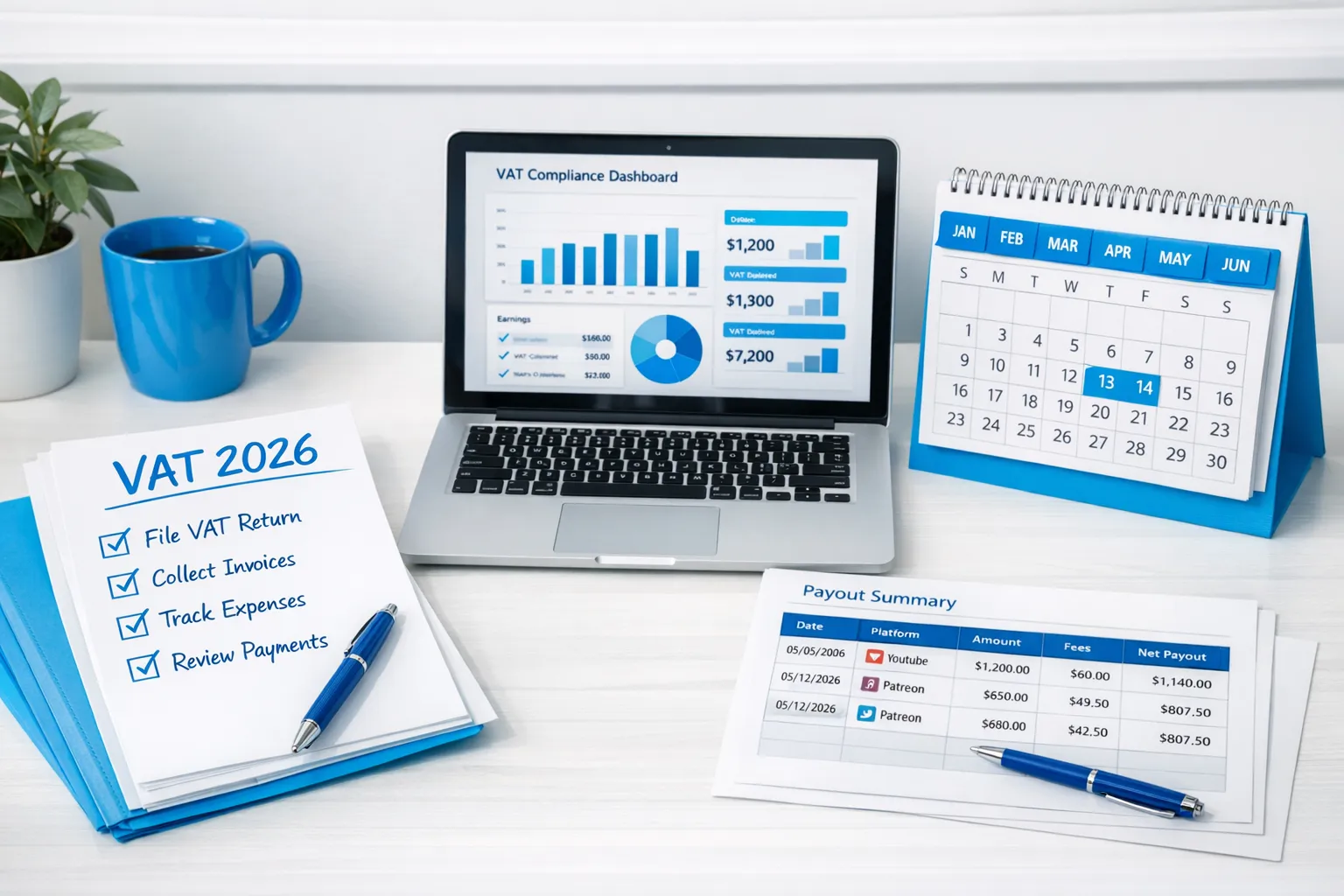
If you want a simple spreadsheet structure, use these columns:
- Date range
- Payout date
- Gross earnings (before platform fees)
- Platform fees/commission
- Net payout received
- Refunds/chargebacks
- Notes (promotions, pricing change, viral week)
Common VAT mistakes OnlyFans creators make (and how to avoid them)
Treating VAT like it’s optional until you “get big”
You do not need to be a top creator to have VAT complexity, especially if you sell directly to international fans. The fix: set up your tracking now, even if your income is still growing.
Mixing personal and business money
This makes it hard to prove what happened. The fix: separate bank account (or at minimum, a separate card) for creator expenses.
Selling off-platform without understanding digital VAT rules
This is the #1 quiet risk. The fix: before you launch a direct checkout, ask a tax pro:
- “Am I supplying digital services B2C?”
- “Do I need VAT/GST registration?”
- “What evidence do I need for customer location?”
Assuming “the platform handles everything” without verifying
Platforms often handle a lot, but your situation can be different based on location, entity setup, and how you sell. The fix: confirm in writing (platform docs, accountant advice).
Working with an accountant: a creator-friendly question template
If you’re booking a call, this script keeps you in control and avoids vague answers.
Questions to ask:
- “In my country, do I need to register for VAT/GST based on my current annual revenue?”
- “For platform earnings, am I treated as selling to the platform or to the end customer?”
- “If I also sell customs directly, how does that change my VAT obligations?”
- “What records should I keep monthly so you can file cleanly?”
- “What are the top 3 VAT mistakes you see with online creators?”
What to bring to the call:
- Last 3 months of payout statements
- A rough breakdown of where your fans are located (even approximate)
- Your off-platform sales method (if any)
- Your business setup (individual, LLC, limited company, etc)
Where an OnlyFans management agency can help (without pretending to be your tax advisor)
A good OnlyFans management agency should not claim to “solve your taxes” for you. Taxes are legal compliance, and you want that handled by a qualified professional.
What an agency can do is reduce the chaos that makes tax time miserable:
- Keeping your earnings predictable with structured promo and pricing strategy
- Organizing reporting so your payouts, chargebacks, and promo periods are easy to explain
- Helping you build a real “business rhythm” so you are not scrambling every month
If you’re at the stage where you want to scale without drowning in admin, Lookstars is built for hands-on support across growth and operations (marketing, 24/7 fan chatting, posting strategy, privacy and leak protection). You can learn more about working with management in these guides:
- When to Hire an OnlyFans Management Agency
- 6 Red Flags to Watch Out for Before Signing with an OnlyFans Agency
- How to Start, Create & Verify Your OnlyFans Account
The simplest way to stay VAT-compliant in 2026
If you only remember four things, make it these:
- VAT is not income tax, and it can apply differently depending on where the customer is.
- Platform sales and direct sales are not the same, VAT risk rises fast when you sell directly.
- Do not guess who remits VAT, verify via platform documentation and a professional.
- Track payouts monthly, because clean records solve most “tax panic” situations.
If you want help building a more stable OnlyFans business (so your finances are easier to manage in the first place), you can apply to work with Lookstars here: Lookstars Agency.



Ready to transform your career?
Join hundreds of creators already earning six figures with Lookstars Agency.
Share this article
Best OnlyFans Agency
Europe's Leading OnlyFans Management Agency.

100% Free Ebook
Get our guide and unlock the secrets to OnlyFans success.
100% Free Ebook
Get our guide and unlock the secrets to OnlyFans success.
Free Revenue Calculator & Profile Analyzer
Try them for freeContinue reading...

Am I Attractive Enough for an OnlyFans Agency? The Answer

Can You Ever Fully Delete Your OnlyFans Content? The Reality