Trans Creator Safety Checklist: Doxxing and Boundaries
If you’re a trans creator, “safety” is not just a buzzword, it’s an operating system. Doxxing can happen from a single careless screenshot, a reused username...
If you’re a trans creator, “safety” is not just a buzzword, it’s an operating system. Doxxing can happen from a single careless screenshot, a reused username, a background detail in a photo, or the wrong person getting too close in your DMs. And boundaries are not “being mean”, they’re a practical security tool that protects your privacy, your time, and your mental health.
This checklist is designed to help you reduce risk today, with clear steps you can implement whether you’re brand new or already earning.
Quick note: This is educational, not legal advice. Platform policies and laws can change, verify anything sensitive in official documentation or with a qualified professional.
What doxxing looks like for trans creators (and why it hits differently)
Doxxing is when someone publicly shares identifying info about you without consent (legal name, address, employer, school, family details, real social profiles). For trans creators, the harm can be amplified because doxxing often comes packaged with:
- Deadnaming and targeted harassment
- Threats and stalking
- Workplace or housing risk
- “Outing” attempts to family or local community
The goal is not to be paranoid. The goal is to reduce easy entry points and have a calm plan if something happens.
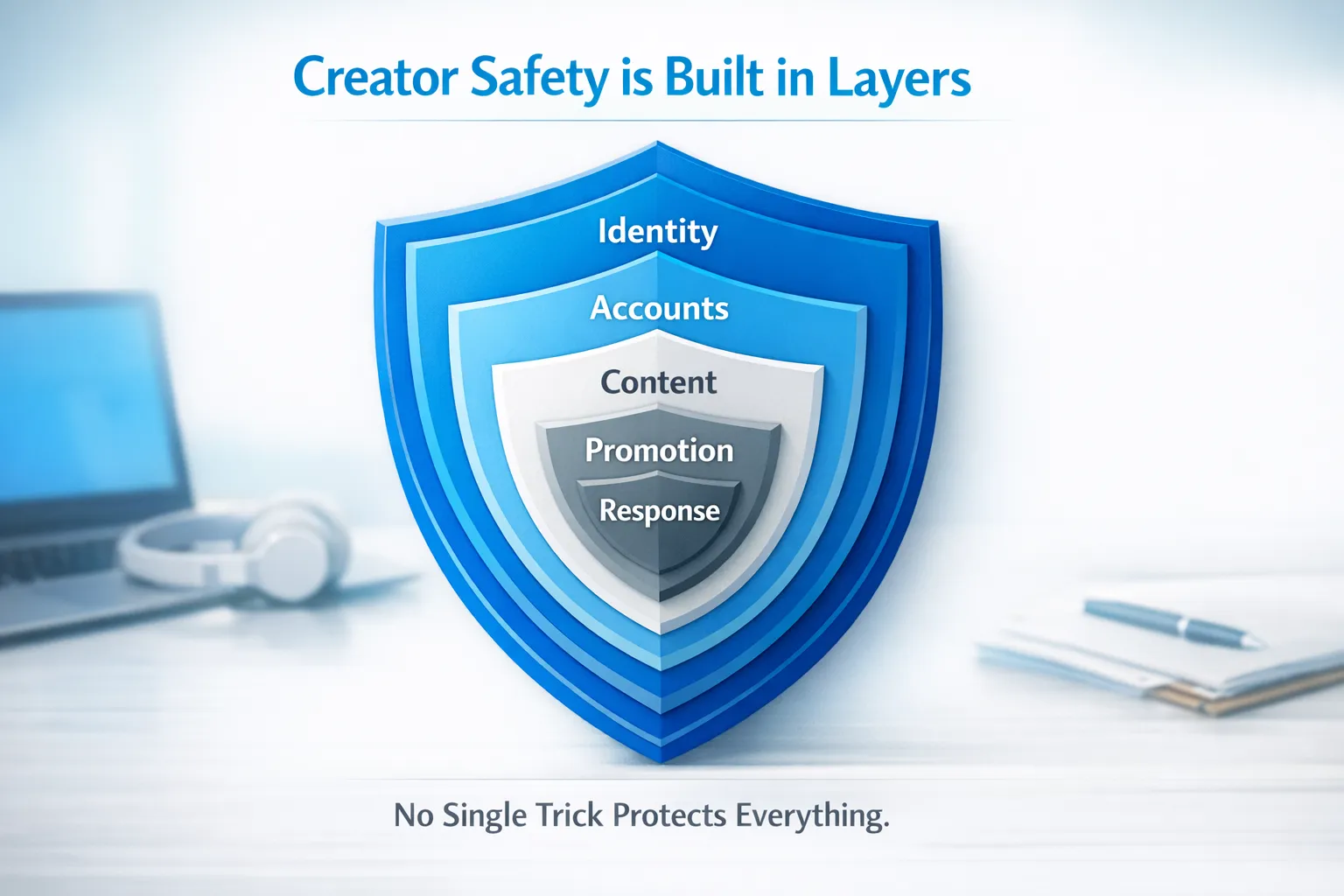
A simple model: the 5 layers of creator safety
Think of your safety like five layers. You do not need perfection in all five, but you do want fewer weak points.
- Identity layer (name, email, phone, mailing)
- Account layer (logins, 2FA, device security)
- Content layer (photos, metadata, watermarking, leaks)
- Promo layer (social media, DMs, collaborations)
- Response layer (what you do if doxxed, threatened, leaked)
Trans creator doxxing prevention checklist (set this up once, then maintain)
1) Build a separate “creator identity stack”
If you only do one thing, do this: do not let your creator identity share recovery paths with your personal life.
Checklist:
- New email only for creator work (and do not forward it to your personal inbox).
- New phone number for creator work if possible (avoid using your day-to-day number for logins and DMs).
- New usernames that are not variations of old handles.
- Separate profile photos (do not reuse selfies from personal social media).
- Separate link hub (do not connect personal domains, personal storefronts, or anything tied to your legal name).
Why this matters: most “identity leaks” come from account recovery, username reuse, or the same profile photo being traceable.
2) Lock down your account layer (anti-takeover basics)
Account takeovers are a common path to doxxing. If someone gains access, they can scrape messages, payment emails, shipping info for customs, and private media.
Checklist:
- Use a password manager and unique passwords for every account.
- Turn on two-factor authentication (2FA) wherever possible.
- Review device security (PIN, FaceID, auto-lock, encrypted backups if available).
- Treat “agency” or “helper” access like a serious security event (more on this below).
For scam patterns and risky setups, see: OnlyFans Scam: How Agencies, Managers and Chatters Rob the Creators.
3) Remove location and identity clues from your content
Doxxers don’t always need “hacking”. They can build your identity from tiny clues.
Checklist:
- Remove metadata (EXIF) from photos before posting elsewhere (many phones embed location data).
- Watch your backgrounds (mail, packages, prescription labels, diplomas, recognizable street views).
- Avoid showing distinctive identifiers repeatedly (tattoos, license plates, unique home layout) if anonymity is a goal.
- Be careful with time patterns (posting “just got home from X restaurant” plus geotagged stories can triangulate).
If faceless or semi-anonymous is part of your safety plan, you may also like: How to Make Money on OnlyFans Without Showing Your Face & Stay Anonymous.
4) Control your mailing and real-world exposure
Many creators get doxxed through “innocent” logistics.
Checklist:
- Do not reveal your home address for any reason.
- If you accept mail, look into a PO box or mail receiving service available in your area.
- Avoid personal Wishlists that show location or real name by default (some services can expose shipping regions).
If you’re considering formal business separation for privacy and operations, read: LLC for OnlyFans: When It Makes Sense. (Educational only, not tax or legal advice.)
5) Use platform privacy features intentionally
Most creators turn on privacy tools after a scare. It’s better to start with them.
Checklist:
- Use country blocking (especially your home country if needed, or countries where you have personal risk).
- Be selective with free trials and who gets access.
- Keep a “no exceptions” rule for sharing private contact details.
For broader stealth and privacy planning, see: How to Secretly Promote Your OnlyFans (Without Friends or Family Finding Out).
6) Content leak protection (assume leaks happen, plan anyway)
Even if you do everything right, leaks can still happen. The goal is to reduce spread and respond fast.
Checklist:
- Add watermarks that are hard to crop (subtle but persistent).
- Keep originals in a secure archive so you can prove ownership.
- Monitor for reposts (manual searching is a start, but it’s time-consuming).
- Use takedown processes when your content is stolen.
Lookstars supports creators with content leak protection (monitoring and DMCA takedowns) and privacy setup so you are not doing this alone. Learn more about what full support can look like here: Working With an Agency vs Running OnlyFans Alone.
Quick risk table: common doxxing vectors and how to reduce them
| Doxxing vector | How it happens | Practical mitigation |
|---|---|---|
| Username reuse | Old handle connects to personal accounts | New handles, no variations, no recycled profile pics |
| Account recovery | Personal email/phone used as backup | Separate email/number, 2FA, unique passwords |
| Background clues | Mail, street signs, landmarks in photos | Clean backgrounds, crop, blur, reshoot |
| Metadata (EXIF) | Location data embedded in images | Strip metadata before posting off-platform |
| “Friendly” DMs | Fan slowly collects details over time | Boundaries, scripts, no personal specifics |
| Collaborations | Partner leaks or gets compromised | Vet partners, written terms, no real-name sharing |
| Leaks/reposts | Stolen content spreads to tube/leak sites | Watermarks, monitoring, takedowns |
Boundaries checklist (this is also anti-doxxing)
Boundaries are easiest when they are pre-decided. If you negotiate in the moment, you will usually give away more than you meant to.
The 4 boundary categories to set in writing
Time boundaries
- Your chat hours (even if you answer daily, you can set windows)
- Your “offline” days
- Response expectations (you do not owe instant replies)
Content boundaries
- What you do not film, period
- What you do only as premium customs
- What needs extra time or a higher price
Personal info boundaries
- No real name, no location, no workplace/school details
- No personal social accounts
- No phone calls or off-platform messaging if that increases your risk
Respect boundaries
- Pronouns and name expectations
- Zero tolerance for deadnaming, slurs, coercion, “prove it” demands
Copy/paste boundary scripts (use them as-is)
You’re allowed to be warm and firm. Here are templates many creators use.
1) Pronouns / respect boundary
“Just a quick note: I’m trans, my pronouns are /, and respectful language is non-negotiable here. If that doesn’t work for you, this won’t be a good fit.”
2) No personal details
“I keep my private life private, so I don’t share my real name, location, or socials. I love flirting here though. Tell me what you’re in the mood for 😈”
3) Off-platform contact request
“I don’t move chats off-platform for safety. If you want something more personal, I can do a custom here.”
4) “Where do you live?” redirect
“I don’t share location details. But I’ll tell you this: I’m way more fun when you focus on what you want from me tonight 😉”
5) Deadnaming or rude comment
“That language isn’t ok with me. If it happens again, I’ll block. If you want to stay, keep it respectful.”
6) Pressure / coercion
“I don’t do anything under pressure. If you want a custom, you can ask politely and I’ll tell you what’s possible.”
Tip: save these as keyboard shortcuts (phone text replacement) so you can respond without emotional labor.
Harassment and threats: what to do (without spiraling)
Harassment is not a personal failure. It’s a reality of being visible online, and trans creators often get targeted more aggressively.
A calm moderation routine
- Do not debate trolls. It gives them engagement and more data.
- Screenshot and document threats (username, time, message, platform).
- Block and report within the platform.
- If someone escalates to stalking or credible threats, consider contacting local law enforcement or a legal professional in your region.
If you need support right now, consider reaching out to:
- Trans Lifeline (peer support)
- GLBT National Help Center
- Cyber Civil Rights Initiative (support related to nonconsensual intimate image abuse)
(Availability and services vary by country. Verify what applies where you live.)
If you get doxxed: a 60-minute response plan
When panic hits, you want a script. Here’s a practical order of operations.
Step 1: Stop the bleed. Lock accounts immediately (change passwords, enable 2FA, revoke sessions). If you suspect a takeover, prioritize email first.
Step 2: Capture evidence. Screenshot posts, URLs, usernames, timestamps. Do this before you report because content sometimes disappears.
Step 3: Report and request takedowns. Use the platform’s reporting tools and any available takedown channels. If content is reposted, start a removal process.
Step 4: Alert your inner circle. Tell one trusted person what’s happening so you’re not handling it alone. If you have a manager or agency, loop them in.
Step 5: Reduce real-world risk. If your address or workplace is exposed, prioritize physical safety. Consider staying with someone you trust and tightening visibility on personal social media.
Step 6: Stabilize your boundaries. Expect “DM fishing” right after an incident. Tighten your scripts and block fast.
If your biggest fear is family or friends finding your account, this deeper guide helps you close common identity leaks: How to Secretly Promote Your OnlyFans (Without Friends or Family Finding Out).
When to get help (and what “help” should never require)
There’s a difference between support and surrender.
It may be time to outsource if:
- You’re spending hours fighting leaks, impersonators, or reposts
- Your DMs are draining you or pulling you into unsafe conversations
- You want growth, but you cannot promote consistently without risking privacy
Red flags (especially important for trans creators)
- They push for full control without transparency
- They won’t explain who chats as you and how your voice stays consistent
- They pressure you into long lock-in contracts
- They dismiss pronoun and identity respect as “not a big deal”
Use this red-flag guide before signing anything: 6 Red Flags to Watch Out for Before Signing with an OnlyFans Agency.
Frequently Asked Questions
Can I do OnlyFans safely as a trans creator? Yes, but “safe” depends on your personal risk level, location, and privacy needs. A layered approach (separate identity, strong account security, careful promo, and a response plan) reduces risk significantly.
What’s the most common way creators get doxxed? Often it’s not hacking, it’s small identity links like reused usernames, personal email/phone recovery, recognizable backgrounds, or oversharing details in DMs over time.
Should I block my home country on OnlyFans? It can reduce local discovery risk, but it’s not a perfect shield (people can travel, use alternative accounts, or consume content elsewhere). Treat it as one layer, not the whole plan.
If someone leaks my content, should I panic and delete everything? Not always. Deleting can remove your income while the leak still exists elsewhere. A calmer approach is to document, report, start takedowns, tighten access, and then decide whether to pause, rebrand, or continue.
Is it safer to work with an OnlyFans management agency? It can be, if the agency is legitimate and privacy-first. A good agency helps with leak monitoring, takedowns, secure operations, and fan management. A bad one can increase risk, so vet carefully.
Want privacy-first support while you grow?
If you’re building your OnlyFans (or scaling it) and you want help that takes safety seriously, Lookstars supports creators with marketing, 24/7 fan chatting, strategic posting, and content leak protection (monitoring and DMCA takedowns), plus privacy features like country blocking and security setup.
Lookstars has no upfront costs and flexible, cancel-anytime contracts, so you can get support without feeling trapped.
Explore resources on the site, or learn what working together could look like at Lookstars Agency.
Ready to transform your career?
Join hundreds of creators already earning six figures with Lookstars Agency.
Share this article
Best OnlyFans Agency
Europe's Leading OnlyFans Management Agency.
100% Free Ebook
Get our guide and unlock the secrets to OnlyFans success.
100% Free Ebook
Get our guide and unlock the secrets to OnlyFans success.
Free Revenue Calculator & Profile Analyzer
Try them for freeContinue reading...
Am I Attractive Enough for an OnlyFans Agency? The Answer
Can You Ever Fully Delete Your OnlyFans Content? The Reality