Stage Name Trademark Basics for OnlyFans Creators
Your stage name is not “just a username.” It’s the label fans remember, search, and recommend. If you ever deal with impersonators, copycat accounts, or some...
Your stage name is not “just a username.” It’s the label fans remember, search, and recommend. If you ever deal with impersonators, copycat accounts, or someone trying to register your name first, you’ll suddenly wish you’d treated it like a real business asset.
This guide explains stage name trademark basics for OnlyFans creators in plain English, including what trademarks do, when it’s worth filing, how to do a quick clearance check, and the privacy tradeoffs you should know before putting anything on a public government database.
Disclaimer: This is educational, not legal advice. Trademark rules and processes vary by country and can change. For anything high-stakes (or if privacy is a concern), verify with official sources or a qualified attorney.
What a trademark protects (and what it does not)
A trademark protects a brand identifier used in commerce, usually a name, logo, or slogan, that tells customers “this is the source.” For creators, that usually means your stage name and sometimes a logo.
But a trademark is not a magic shield for everything around your brand. Here’s the simple breakdown:
| Brand asset | What it protects | What it doesn’t protect | Example for creators |
|---|---|---|---|
| Trademark (name/logo) | Your brand identity in specific categories of goods/services | Your actual content, leaks, or someone merely “using a similar vibe” | Stopping another seller from marketing paid content under a confusingly similar name |
| Copyright | Creative works you created (photos, videos, writing) | Your name, short phrases, or your “persona” | DMCA takedowns for reposted content |
| Platform username/handle | Your username on that platform | Your name everywhere else | Having @YourName on X does not stop an imitator on TikTok |
| Domain name | Control of that website address | The underlying brand name | Owning YourName.com doesn’t automatically give you trademark rights |
Key point: a trademark is about consumer confusion. It’s designed to stop someone from using a name that makes buyers think they’re buying from you.
“Do I need to trademark my stage name?” A realistic decision framework
A trademark filing takes time, money, and emotional bandwidth. Some creators file too early and resent it. Others wait too long and end up stuck in a messy rebrand.
Use this framework to decide what makes sense right now.
Filing sooner tends to make sense if...
- You’re committed to your stage name for the long haul (you’re not still experimenting).
- You’re expanding beyond one platform (OnlyFans plus Fansly, clip sites, OFTV, etc.).
- You’re investing in paid marketing, collaborations, or press.
- You’re getting consistent impersonation problems.
- You plan to sell products tied to your name (merch, paid communities, paid coaching, digital downloads).
- Your name is distinctive (not generic) and is becoming recognizably “you.”
Waiting can be smarter if...
- You change your branding every few months.
- Your stage name is very generic (harder to protect, higher risk of conflict).
- You are early-stage and your bigger risk is not copycats, it’s privacy and stability.
- You are not ready for your stage name to be connected to any public record in your country (even indirectly).
A quick “readiness” checklist
- Name stability: I’d still use this name a year from now.
- Cross-platform: I’m using it in multiple places, not only one profile.
- Proof of use: I can show the name used to sell my services/content.
- Search results: When you search the name, it mostly points to you.
- Privacy plan: I know how I’ll handle addresses, business entity, and public records.
If you’re not confident in name stability yet, start by choosing a strong stage name and building consistent handles. This guide on naming can help: Best OnlyFans name ideas.
Before you spend money: how to do a basic “clearance” search
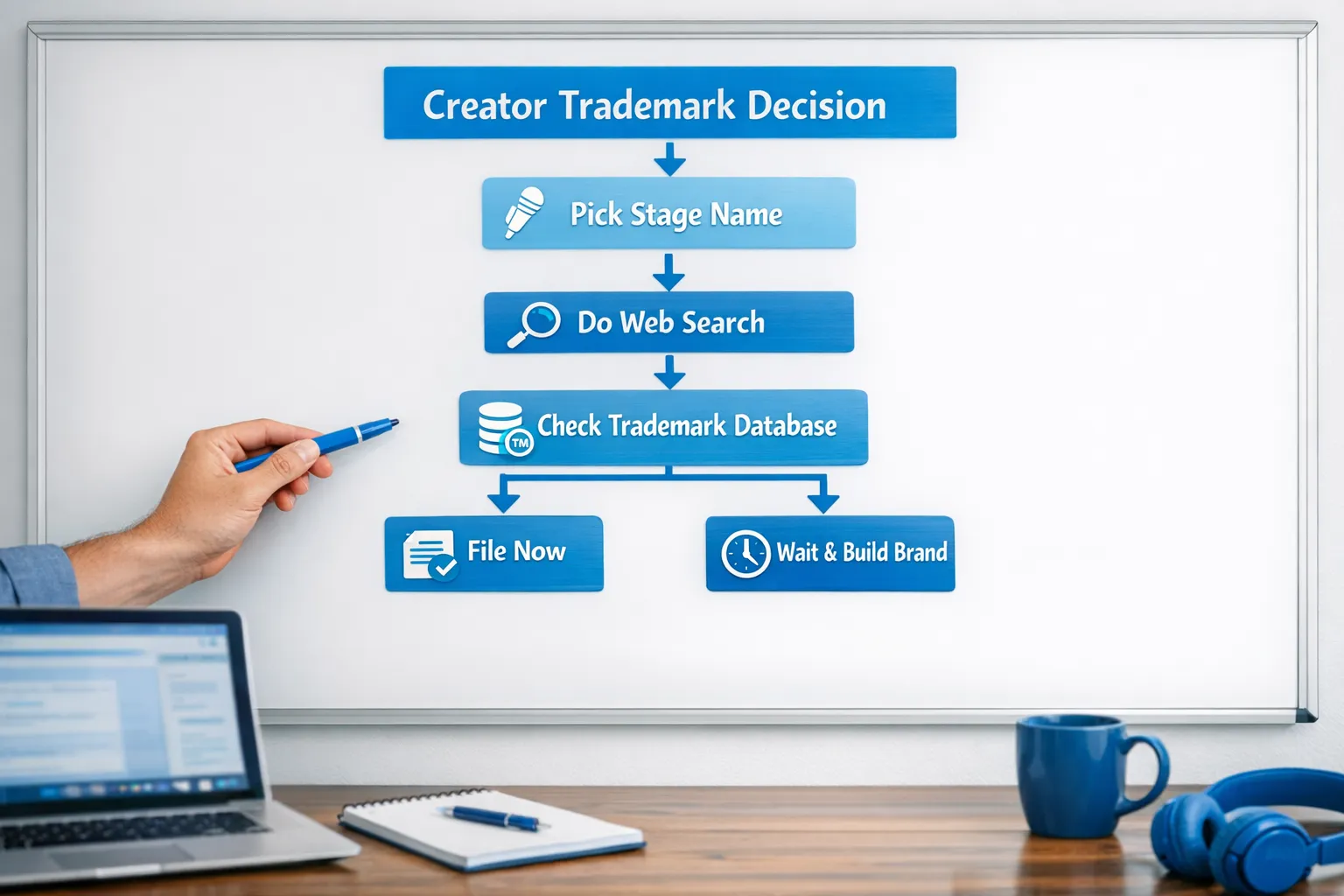
You’re not trying to become a trademark attorney overnight. You’re trying to avoid the most common mistake: falling in love with a name that’s already taken (or too close).
Step 1: Search like a fan would
- Google the exact name and close variations.
- Search on X, Instagram, TikTok, Reddit, and your niche platforms.
- Check common misspellings.
If you find a creator using the same name in a similar paid-content space, assume you might have a problem.
Step 2: Search official trademark databases (at least in your main market)
If your main market is the US, start with the USPTO’s trademark search tools (the USPTO site is the official source: USPTO trademarks). Other countries have their own databases.
What you’re looking for:
- The same name (or something extremely close).
- Used for similar services.
- Still active (not abandoned).
Step 3: Ask “would a buyer be confused?”
Two names don’t need to be identical to create trouble.
Consider:
- Sound-alikes (KylaKiss vs KylaKisz)
- Same meaning (VelvetVixen vs VelvetFox)
- Same niche audience and platform environment
Step 4: If it looks even slightly messy, pause
This is where getting professional advice can be worth it. The cost of a rebrand after you’ve built a fanbase is usually higher than the cost of doing the process properly.
Filing options (and what changes for creators)
Even if you never file, you can still build brand protection habits. If you do file, your route matters.
| Option | Best for | Upside | Tradeoffs (especially for creators) |
|---|---|---|---|
| No filing (brand hygiene only) | New creators testing names | No cost, no paperwork | Weak leverage if a copycat grows fast |
| “Common law” use (varies by country) | Creators building local reputation | Some rights may exist based on use | Harder to enforce, unclear boundaries |
| National trademark filing (ex: US) | Creators building a serious long-term brand | Stronger legal position in that country | Time, cost, and public record exposure |
| International strategy | Creators with heavy global reach | Aligns protection with where money comes from | Complexity and more cost |
A few creator-specific realities:
- Your “service” category matters. Trademarks are registered in specific classes/categories. You don’t automatically own the name for everything on Earth.
- Adult creators still need normal business protection. Being in adult doesn’t make you less entitled to brand protection, but you may face extra impersonation and leak issues.
- A trademark will not stop leaks by itself. Leaks are usually a copyright and enforcement problem, not a trademark problem.
Privacy: the part nobody warns creators about
A big reason creators hesitate is totally valid: many trademark filings become public records. Depending on where and how you file, your legal name and address might be visible.
If anonymity is part of your safety plan, think this through before you do anything.
Privacy-first questions to ask before filing
- Will the filing display my personal name or can it be done through a business entity?
- Will my home address be public, and can I use an appropriate alternate address?
- If I use an attorney or agent, can their address be used for correspondence?
- If I ever need to enforce the trademark, am I okay with the possibility of more exposure?
If your bigger concern is staying anonymous (family, coworkers, local community), build your privacy setup first. This article covers practical steps creators use: How to secretly promote your OnlyFans (without friends or family finding out).
Reminder: This is educational, not legal advice. For privacy-sensitive filing decisions, talk to a qualified professional in your country.
Common mistakes creators make with stage name trademarks
1) Choosing a name that is hard to protect
Names that are very generic or descriptive tend to be harder to own.
Instead of:
- “Hot Blonde Babe”
Think:
- A distinctive stage name that still fits your vibe and niche
If you’re still picking a name, start with a brandable approach (short, memorable, consistent across platforms). Lookstars’ naming guide can help you pressure-test ideas: Best OnlyFans name ideas.
2) Accidentally building on someone else’s brand
Avoid names that include other brands or sound like them. It can create enforcement risk and forced rebrands.
3) Thinking “I bought the domain, so I own the trademark”
Domains and trademarks are separate systems. Owning a domain is smart, but it’s not the same as owning the name legally.
4) Waiting until a copycat is already established
Once someone else is using your name (or a confusingly similar one) and has built a following, everything becomes harder: platform reporting, customer confusion, and emotional stress.
If you work with an agency/manager, protect your stage name in writing
This is the part I want you to read slowly.
If anyone helps you run your account (agency, manager, chatter team, marketer), you need crystal clarity on brand ownership.
Contract checklist: stage name and IP ownership
Use these as “questions to ask before you sign” points:
- Who owns the stage name and branding? (You, always, unless you explicitly choose otherwise.)
- If trademarks are filed, whose name/entity is the owner?
- Who pays filing fees and who controls the trademark account?
- If you leave, do you keep all brand assets and usernames?
- Does the contract restrict your ability to rebrand or use your name elsewhere?
- Are you allowed to keep your content library and marketing assets?
If a partner dodges these questions, treat it like a serious warning sign.
For broader safety vetting, these two guides are worth reading:
- 6 red flags to watch out for before signing with an OnlyFans agency
- OnlyFans agency scams: how agencies, managers and chatters rob creators (and how to stay safe)
Trademark is one layer, not the whole “brand protection” plan
In real creator life, your stage name is protected by a stack of habits, not one document.
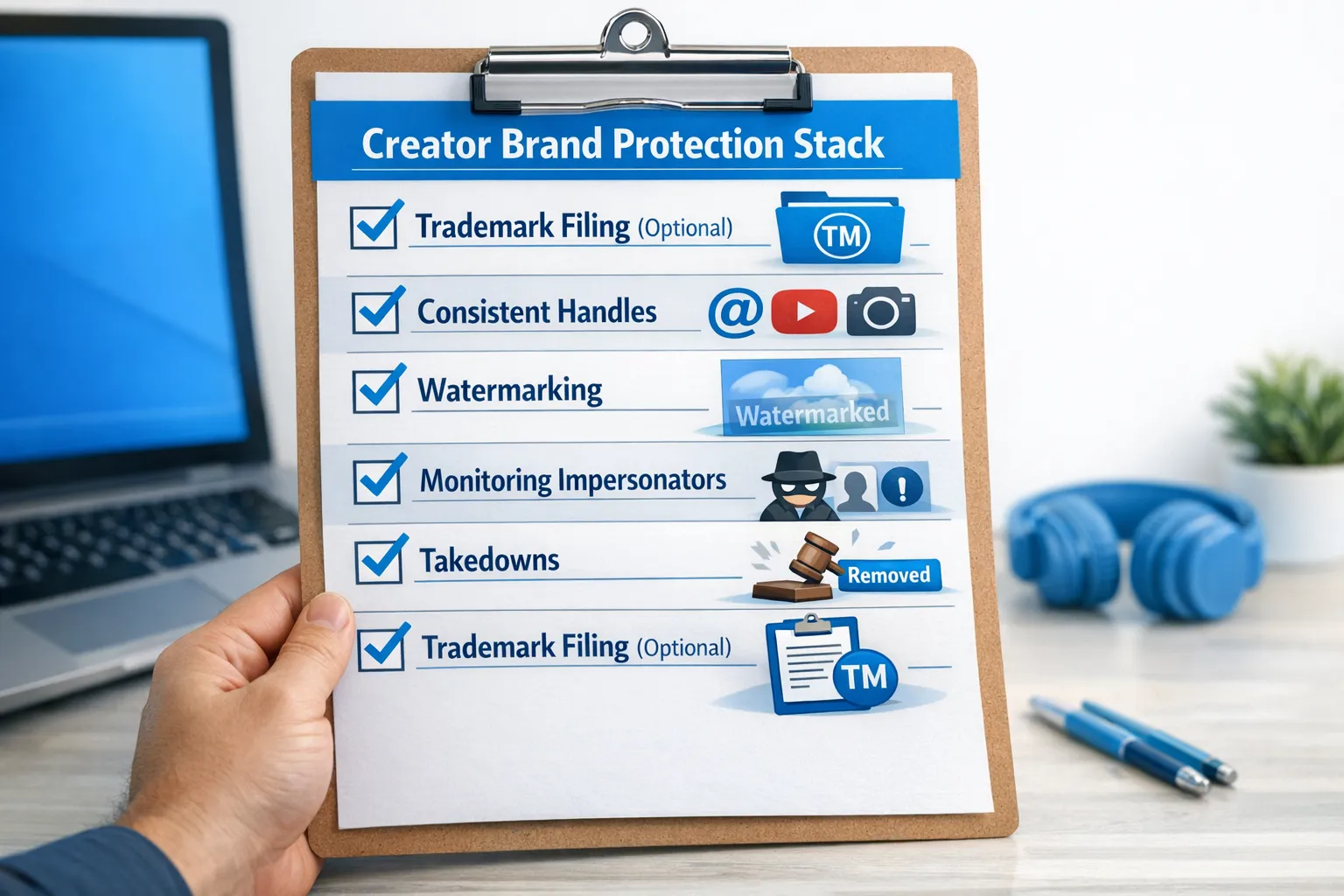
Here’s a simple brand protection stack that works even if you never file:
- Consistent handles: claim the same name (or closest match) across platforms.
- Consistent visuals: repeat the same watermark style and brand cues.
- Documentation: keep receipts and timestamps of your earliest usage.
- Impersonation monitoring: search your name regularly on the platforms that drive your traffic.
- Leak response plan: know who handles takedowns, how you document infringements, and how you prioritize the biggest leak sources.
If you’re at the point where you want a team to handle growth, DMs, and protection tasks while you focus on content, that’s exactly what a full-service OnlyFans management agency is for. You can learn more about Lookstars here: Lookstars Agency.
A calm, practical next step
If you’re unsure, don’t force a filing out of fear. Do this instead:
- Commit to a stage name you won’t hate in six months.
- Run a basic web and trademark database search.
- Lock your handles and domain.
- Build a privacy plan before you put anything into a public process.
And if you’re already earning, already being copied, or planning to scale hard across platforms, it may be time to talk to someone qualified about trademark strategy.
If you want help building and protecting your creator business (marketing, 24/7 fan chatting, posting strategy, leak protection, and privacy setup), you can apply here: Lookstars Agency.

Ready to transform your career?
Join hundreds of creators already earning six figures with Lookstars Agency.
Share this article
Best OnlyFans Agency
Europe's Leading OnlyFans Management Agency.
100% Free Ebook
Get our guide and unlock the secrets to OnlyFans success.
100% Free Ebook
Get our guide and unlock the secrets to OnlyFans success.
Free Revenue Calculator & Profile Analyzer
Try them for freeContinue reading...
Am I Attractive Enough for an OnlyFans Agency? The Answer
Can You Ever Fully Delete Your OnlyFans Content? The Reality