How Much Do OnlyFans Agencies Really Take? (Real Splits Explained)
Most creators don’t get “robbed” by an agency because the percentage is high. They get robbed because the percentage is unclear. . . When you Google “how muc...

Most creators don’t get “robbed” by an agency because the percentage is high. They get robbed because the percentage is unclear.
When you Google “how much do OnlyFans agencies take,” you’ll see a lot of confident answers and not enough math. So let’s make this practical: what a split actually means, how it’s calculated, what you should expect to pay for, and how to spot a deal that will quietly drain you.
Start with the non-negotiable cut: OnlyFans takes its share first
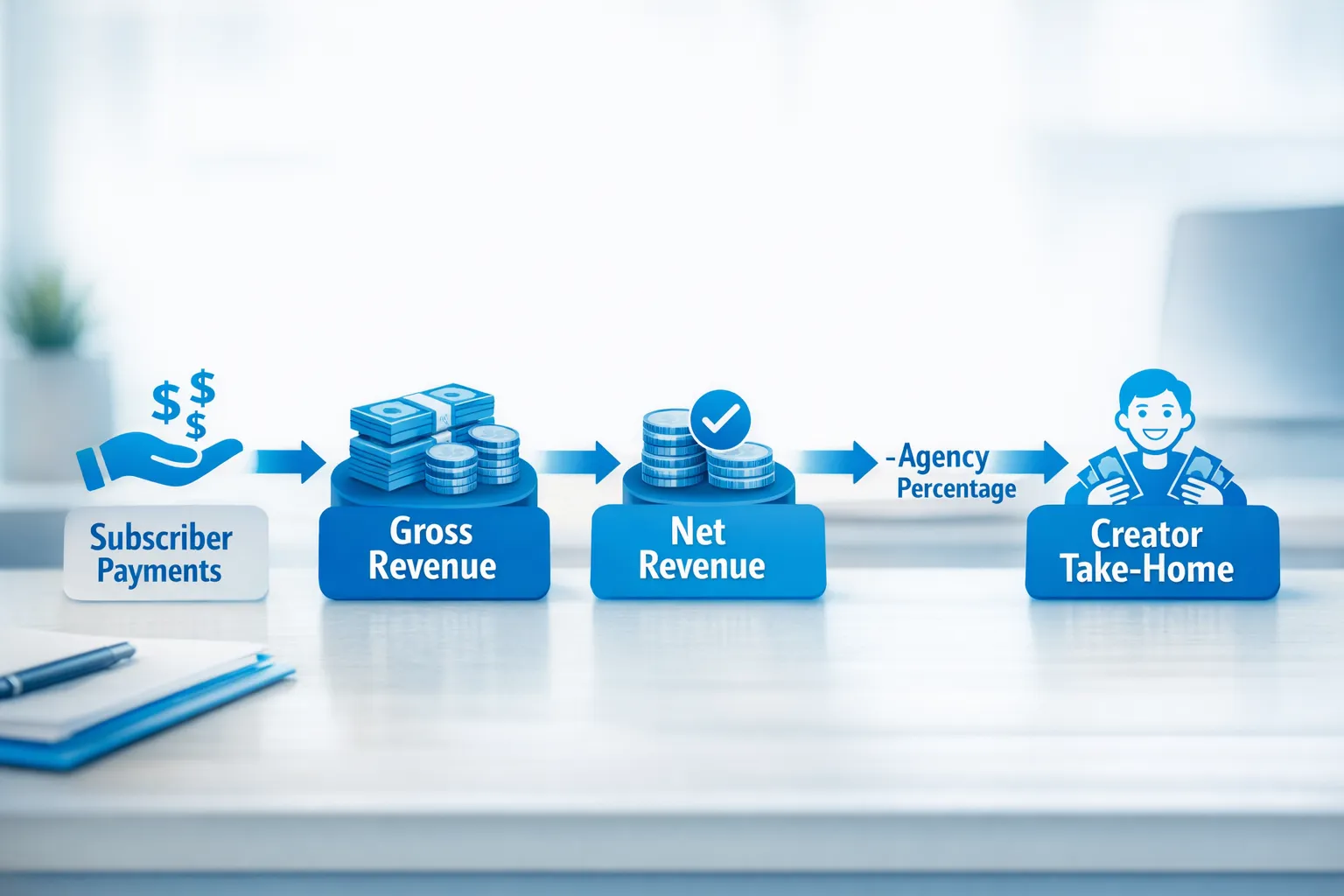
Before any agency discussion, remember that OnlyFans itself keeps a platform fee (often referenced as 20%, but policies can change, so verify the current rate in the official OnlyFans Terms).
That matters because agencies describe their split in two different ways:
- Split on gross (before the platform fee)
- Split on net (after the platform fee)
Those two phrases can turn a “40% agency fee” into two very different outcomes.
The 4 common ways OnlyFans agencies charge (and what each really means)
There isn’t one universal standard. You’ll see different structures based on how “full service” the management is, how established you are, and how much work they’re truly taking off your plate.
Here are the models you’ll run into most often.
| Pricing model | How it works | Best for | Watch-outs |
|---|---|---|---|
| Revenue share (percentage split) | Agency takes a % of revenue (gross or net, define it) | Creators who want full help without paying upfront | Confusing “gross vs net,” hidden add-ons, long lock-in contracts |
| Retainer (fixed monthly fee) | You pay a flat fee for specific services | Established creators with predictable cash flow | Paying even during slow months, unclear scope boundaries |
| Hybrid | Smaller retainer + smaller % | Creators who want stability but still want agency incentives | Double-dipping if the retainer does not replace anything |
| A-la-carte (chat only, marketing only, etc.) | You pay for one function, sometimes hourly or per commission | Creators who are strong in some areas but stuck in one | Tools/access/security risks, inconsistent quality, no strategy layer |
A simple way to sanity-check any model is to ask: “If my income doubles, what changes in your workload?”
- If they’re doing performance marketing, analytics, and running a real chat operation, workload often scales.
- If they’re basically posting for you once a day and collecting a percentage, it doesn’t.
What you are actually paying for (the “real cost” behind the split)
A percentage only makes sense if it replaces tasks you’d otherwise do yourself or hire for.
A legitimate full-service OnlyFans management agency typically covers a mix of:
- OnlyFans marketing and fan growth (multi-platform, testing creatives, tracking links, analytics)
- 24/7 fan chatting (sales, PPV, customs upsells, retention, reactivation)
- Strategic posting management (calendar, timing, offer planning)
- Privacy and leak protection (monitoring, DMCA takedowns, impersonation checks)
- Security setup (country blocking, account safety, workflow privacy)
If you want a deeper breakdown of what a real manager does vs what shady “managers” claim, this is worth reading: What can an OnlyFans manager really do for you in 2025?
“Real splits” explained with actual math (gross vs net)
Let’s use a clean, round example so you can see what changes.
Assume:
- Subscriber revenue + PPV + tips = $10,000 gross
- OnlyFans platform fee = 20%
- Agency fee = 40% (but we will define two different ways)
Scenario A: 40% on net (after platform fee)
- Gross: $10,000
- After platform fee (net): $8,000
- Agency takes 40% of $8,000 = $3,200
- Creator receives $4,800
Scenario B: 40% on gross (before platform fee)
- Gross: $10,000
- Agency takes 40% of $10,000 = $4,000
- OnlyFans still takes its fee from gross, so you receive $8,000 from the platform
- You pay the agency $4,000 from that $8,000
- Creator receives $4,000
Same “40% fee,” different take-home.
Here’s the comparison in one table:
| Example | Gross revenue | Platform fee (20%) | Net after platform | Agency fee basis | Agency takes | Creator keeps |
|---|---|---|---|---|---|---|
| A: 40% of net | $10,000 | $2,000 | $8,000 | Net | $3,200 | $4,800 |
| B: 40% of gross | $10,000 | $2,000 | $8,000 | Gross | $4,000 | $4,000 |
What to insist on: the contract should define the calculation in one sentence you can’t misread.
“Agency fee is X% of net receipts from OnlyFans payouts (after platform fees), excluding chargebacks/refunds.”
(Then define chargebacks/refunds too, because that’s another place creators get surprised.)
The “hidden” deductions that change your real split
Even when an agency says “we take 30%,” your real cost can creep up if the agreement includes extra deductions.
Common examples creators miss:
- Chargebacks and refunds: Who eats them? Are they deducted before the split?
- Paid promotion spend: Are you paying out-of-pocket, or is spend deducted from revenue before splitting?
- Tools and software: Some agencies pass through tool costs.
- Content production costs: Editing, shoot day support, photographers, studio fees.
None of those are automatically bad. They’re only bad when they’re not clearly disclosed.
If you want a practical way to track what actually converts and where money is coming from, learn how to set up attribution correctly: OnlyFans Tracking Links Guide.
So how much do OnlyFans agencies “really take”?
In the market, you will see everything from low-percentage arrangements to aggressive 50%+ deals, and sometimes even higher when an “agency” is actually financing paid traffic or doing heavy production.
But here’s the honest truth:
- There is no single “fair” percentage.
- A split is only fair relative to scope, transparency, and exit terms.
Instead of hunting for the “average,” evaluate the deal like a business owner.
A simple decision framework: agency vs solo vs hiring one person
If you’re deciding whether a split is worth it, compare it to the realistic alternatives.
| Option | What you gain | What you risk | Who it fits best |
|---|---|---|---|
| Solo | Full control, keep all revenue (minus platform fee) | Burnout, slow growth, inconsistent DMs, missed sales windows | Creators with time, discipline, and comfort marketing daily |
| Hire a chatter only | More DM coverage, more PPV opportunity | Quality varies a lot, brand voice issues, security risks | Creators with strong traffic but weak DM monetization |
| Hire a marketer/editor only | Better content funnel and top-of-funnel growth | Still stuck in DMs, no retention system | Creators with good chat conversion but low traffic |
| Full OnlyFans agency | Combined growth + chatting + strategy + ops support | Highest cost, potential loss of control, contract risks | Creators who want to scale and treat it like a business |
A quick self-diagnosis:
- If traffic is low: a chatter alone won’t fix your income.
- If DMs convert poorly or you reply late: marketing alone won’t fix your income.
- If you’re doing “everything” and still plateaued: full management starts making more sense.
For a deeper read on timing and readiness, see: When to hire an OnlyFans management agency.
What a “good” split often depends on (not just the percentage)
Here are the variables that usually justify a higher or lower take.
1) Services included (and whether they’re real)
A true full-service deal usually includes professional chat systems, structured PPV strategy, multi-platform promotion, and leak protection.
If the “agency” is basically:
- reposting your TikToks,
- sending generic mass DMs,
- and calling it “management,”
then even a smaller percentage can be overpriced.
2) Your current revenue and leverage
Creators who already have strong revenue and consistent content tend to negotiate better terms because the agency’s risk is lower.
Beginners sometimes accept harsher splits because they want:
- a fast setup,
- a growth system,
- and someone to carry the operational load.
The deal can still be worth it, but only if the contract is clean and you can leave if it’s not working.
3) Contract length and exclusivity
Shorter agreements with a clear exit are safer for creators, but some agencies push for long lock-ins.
If an agency wants exclusivity, ask what you get in return:
- dedicated team?
- guaranteed response times?
- specific deliverables?
If it’s “exclusive because we said so,” that’s not a benefit.
4) Compliance and account safety
If the agency pressures you into shady tactics that could get you restricted or banned, that split is infinitely too expensive.
This is one reason you should read red flags before signing anything: 6 Red Flags to Watch Out for Before Signing with an OnlyFans Agency.
Scam patterns that inflate what agencies “take”
Some of the worst deals are not the highest percentage, they’re the ones that quietly add risk and hidden costs.
Common patterns:
- They won’t clearly explain gross vs net.
- They dodge a video call or refuse to show who is actually on the team.
- They promise guaranteed income or unrealistic timelines.
- They ask for full account access without basic security standards (2FA, controlled permissions, clear login procedures).
- They push tactics that violate platform rules (“we have a trick that can’t be mentioned in writing”).
- They charge upfront “setup fees” and disappear.
If you want the full breakdown of how creators get exploited (and how to protect yourself), read: OnlyFans Scam: How Agencies, Managers and Chatters Rob the Creators.
Questions to ask before you agree to any split (copy and paste this)
These questions are designed to force clarity. A legitimate agency will answer them without getting defensive.
Split and payment terms
- Is your fee calculated on gross or net? Put the definition in writing.
- Are chargebacks/refunds deducted before the split?
- How often do you pay out, and what proof do I get?
- Are there any additional fees (tools, editing, ads, “team fees”)?
Scope and deliverables
- Who does the chatting, and what training do they have?
- What does “marketing” include (platforms, posting volume, testing)?
- Will you help with leak protection and takedowns? What is the process?
Control, privacy, and brand
- What content, identity, and account access do you require?
- Can I approve offers, pricing, and boundaries?
- How do you handle country blocking and privacy setup?
Contract and exit
- What is the minimum term and how do I cancel?
- Are there penalties, notice periods, or “buyouts”?
- What happens to accounts, content libraries, and login credentials when we end?
If they won’t put the answers in writing, assume the worst version of the deal is the real one.
A quick “is this split worth it?” checklist
Use this as a go/no-go filter.
- Clarity: I understand exactly how the split is calculated (gross vs net) and what deductions apply.
- Scope: The services match my real bottleneck (traffic vs conversion vs retention vs safety).
- Proof: They can show real operational competence (not just screenshots).
- Safety: They do not push rule-breaking tactics.
- Transparency: I know who is on chat and how my brand voice is protected.
- Exit: I can leave without being trapped or losing my assets.
If you can’t check at least 5 out of 6, keep looking.
Where Lookstars fits (and how to compare fairly)
If you’re comparing agencies, compare on clarity + scope + safety, not hype.
Lookstars is a full-service OnlyFans management agency focused on helping creators scale through marketing, fan engagement, privacy protection, and business management. Based on their stated offer, they emphasize:
- Multi-platform marketing and analytics
- 24/7 fan chatting (DM sales, PPV, customs)
- Strategic posting management
- Content leak protection (monitoring + DMCA takedowns)
- Country blocking and privacy setup
- No upfront costs and flexible cancel-anytime contracts
- Weekly payouts
If you want to zoom out and evaluate ROI and timelines realistically, pair this article with: Are OnlyFans Agencies Worth It? A Detailed Review.
If you’re ready to explore management, you can learn more about Lookstars here: Lookstars Agency.
Bottom line
A fair agency split is not a magic percentage. It’s a transparent, well-defined agreement where:
- you know exactly what revenue the fee applies to,
- you know exactly what services you’re getting,
- you keep control of your boundaries and brand,
- and you can exit cleanly if it’s not working.
If you want, share the split terms you were offered (just the structure, not personal info) and I can help you sanity-check the math and the contract language.


Ready to transform your career?
Join hundreds of creators already earning six figures with Lookstars Agency.
Share this article
Best OnlyFans Agency
Europe's Leading OnlyFans Management Agency.
100% Free Ebook
Get our guide and unlock the secrets to OnlyFans success.
100% Free Ebook
Get our guide and unlock the secrets to OnlyFans success.
Free Revenue Calculator & Profile Analyzer
Try them for freeContinue reading...
Am I Attractive Enough for an OnlyFans Agency? The Answer
Can You Ever Fully Delete Your OnlyFans Content? The Reality