OnlyFans Gay Creator Collabs: How to Vet Partners
Collabs can be a cheat code for growth, but they can also be a fast way to invite drama, leaks, or straight-up scams into your business. . . For gay creators...
Collabs can be a cheat code for growth, but they can also be a fast way to invite drama, leaks, or straight-up scams into your business.
For gay creators in particular, collabs often move faster than other niches because the audience is so collaboration-friendly, and the content can be more “event-based” (drops, premieres, partner appearances). That speed is exactly why vetting matters.
This guide gives you a practical, safety-first system to vet collab partners, protect your boundaries, and make sure the collab is worth the time.
First, decide what kind of “collab” you’re actually doing
A lot of creators get burned because they think they’re agreeing to “a collab,” but the other person is picturing a totally different deliverable.
Before you vet anyone, pick the collab format, because the risk profile changes.
| Collab type | What it is | Best for | Main risks to manage |
|---|---|---|---|
| SFS (shoutout for shoutout) | You promote each other, no content shot together | Testing audience overlap fast | Fake stats, low-quality traffic, spammy partners |
| Bundle swap | You each sell a bundle featuring the other (separate shoots) | Faceless or privacy-first creators | Content reuse disputes, “where can I use this” confusion |
| Joint shoot (posted on both pages) | You film together and both publish | Fastest credibility boost | Consent, content ownership, leak risk, safety |
| Guest appearance (posted on one page) | Only one creator posts the collab | Cleaner rights and branding | “I didn’t get my share” disputes |
| Live stream together | Joint live session | Engagement and tips | Moderation, pressure, impulsive boundary slips |
If you’re newer, start with SFS or bundle swaps before meeting anyone in person. If you already have a strong brand and clear boundaries, joint shoots can work, but only with a real vetting process.
If you need a refresher on collab basics (especially SFS mechanics), read: How to Collaborate With Other OnlyFans Creators & Use SFS to Boost Your Revenue.
The vetting mindset: treat it like hiring, not dating
A good collab partner is not “hot” or “popular.” A good partner is:
- Reliable (shows up, communicates clearly, follows agreements)
- Safe (consent-first, privacy-aware, doesn’t pressure)
- Compatible (audience overlap, similar content vibe, similar boundaries)
- Professional (clear about deliverables, timelines, usage rights)
You’re not being paranoid. You’re being a business owner.
Step 1: Run the “3-fit check” before you even reply
This takes 5 minutes and eliminates most bad matches.
Audience fit
Ask: “Would my paying fans realistically buy them, and would their fans buy me?”
Quick tells:
- Similar content style (soft vs explicit, romantic vs rough, kink vs vanilla)
- Similar positioning (boyfriend vibe, gym guy, twink/otter/bear aesthetics, niche roleplay)
- Similar price point strategy (low sub + PPV heavy vs premium sub)
If your vibe is premium and private, collabing with someone who runs constant $3 promos and mass DMs can bring you the wrong audience.
Boundary fit
If either of you has hard lines (face, tattoos, specific acts, toys, naming, substance use, filming angles), you need alignment.
Misalignment here causes 90% of collab drama.
Ops fit
If they take 3 days to answer a simple question now, it won’t get better on shoot week.
Step 2: Verify they’re real (and not a catfish or “agency-run lure”)
You don’t need to be rude, you need to be certain.
A simple verification package to request
Ask for these before any planning call:
- A quick selfie video saying today’s date and a unique phrase you choose
- Their OnlyFans/Fansly handle (and any promo accounts)
- A short screenshot screen recording of their profile page (to match handles)
If they refuse all verification, treat it as a no.
Check consistency across platforms
Look for:
- Same face/body markers (tattoos, moles) or consistent “no-face” style
- Similar writing voice and posting cadence
- Not brand-new accounts with purchased-looking followers
If you rely on Twitter/X for collabs, this guide helps you spot real promo patterns: Marketing OnlyFans on Twitter (X): What actually works in 2025).
Step 3: Do a 10-minute boundaries call (non-negotiable)
Text is where misunderstandings happen. A short call is where professionalism shows.
On the call, you’re listening for:
- Do they respect “no” without negotiation?
- Do they talk about consent like it’s normal?
- Do they push urgency (“let’s shoot tonight”)?
- Do they blame other creators (“everyone’s crazy, I’m the victim”)?
Questions that instantly reveal red flags
Use a few of these word-for-word:
- “What are your hard boundaries on-camera and off-camera?”
- “What do you need to feel safe and not pressured during a shoot?”
- “How do you handle it if one of us wants to stop mid-scene?”
- “What’s your process for releases, tagging, and paperwork?”
- “Do you work with a manager or agency, and if yes, who will be involved?”
If they mock paperwork or act offended by safety questions, that’s your answer.
Step 4: Align on paperwork and platform compliance (without guessing)
Platforms can require releases or tagging when featuring another person. Policies change, and you should verify the current requirements in official platform documentation.
What you can do safely, regardless of platform updates:
- Use a written collab agreement (even if it’s simple)
- Store proof of consent (signed release or written confirmation)
- Keep a folder with IDs verified through the platform where applicable
If you’re doing couples or partner content regularly, this article covers the operational reality (and why written agreements matter): Complete OnlyFans Couples Guide.
Step 5: Set the money terms before you shoot
Collab money gets messy when creators skip specifics.
You’re not trying to “trust less,” you’re trying to protect the friendship and the bag.
Pick one monetization model
Choose one model and write it down:
- Each posts on their own page and keeps their own earnings
- One posts, one gets a flat fee
- Revenue share on a specific set of posts (define the tracking window)
Avoid vague “we’ll split it fairly.” Define:
- Which posts count
- For how long (example: first 30 days)
- What’s included (PPV, tips, bundles)
- Payout timing
If you want to measure whether collabs bring real subscribers (not just likes), use tracking links: OnlyFans Tracking Links Guide.
Step 6: Agree on content ownership and usage rights (this is where leaks start)
Most collab conflicts are not about sex. They’re about:
- Who can post which clips
- Whether you can resell in bundles later
- Whether it can be used in promos
- Whether it can be uploaded to other platforms
A creator-friendly “usage rights” checklist
Put these in writing:
- Where it can be posted (OnlyFans, Fansly, clip sites, socials)
- Promo allowance (teasers allowed, length limits, watermark requirements)
- Editing rules (no face reveal, no doxxing details, blur tattoos if needed)
- Resale rules (allowed or not, and whether permission is needed each time)
- Deletion/removal process (what happens if someone withdraws consent for future use)
Important: consent and contracts are related, but not identical. If you’re unsure how to structure agreements in your jurisdiction, talk to a qualified professional.
Step 7: Safety planning for in-person shoots
This isn’t about fear, it’s about being able to relax because you planned.
Physical safety checklist (simple, not dramatic)
- Meet in a neutral public place first if it’s your first time
- Tell a friend where you are, and set a check-in time
- Control your transportation (so you can leave anytime)
- Keep alcohol/substances out of the shoot if it affects boundaries
STI and health conversations (keep it adult and respectful)
This is educational, not medical advice.
If your collab involves any sexual contact, discuss:
- Testing expectations and timing
- Protection and what “safe” means to each of you
- What happens if someone changes their mind in the moment
A professional partner will not shame you for having standards.
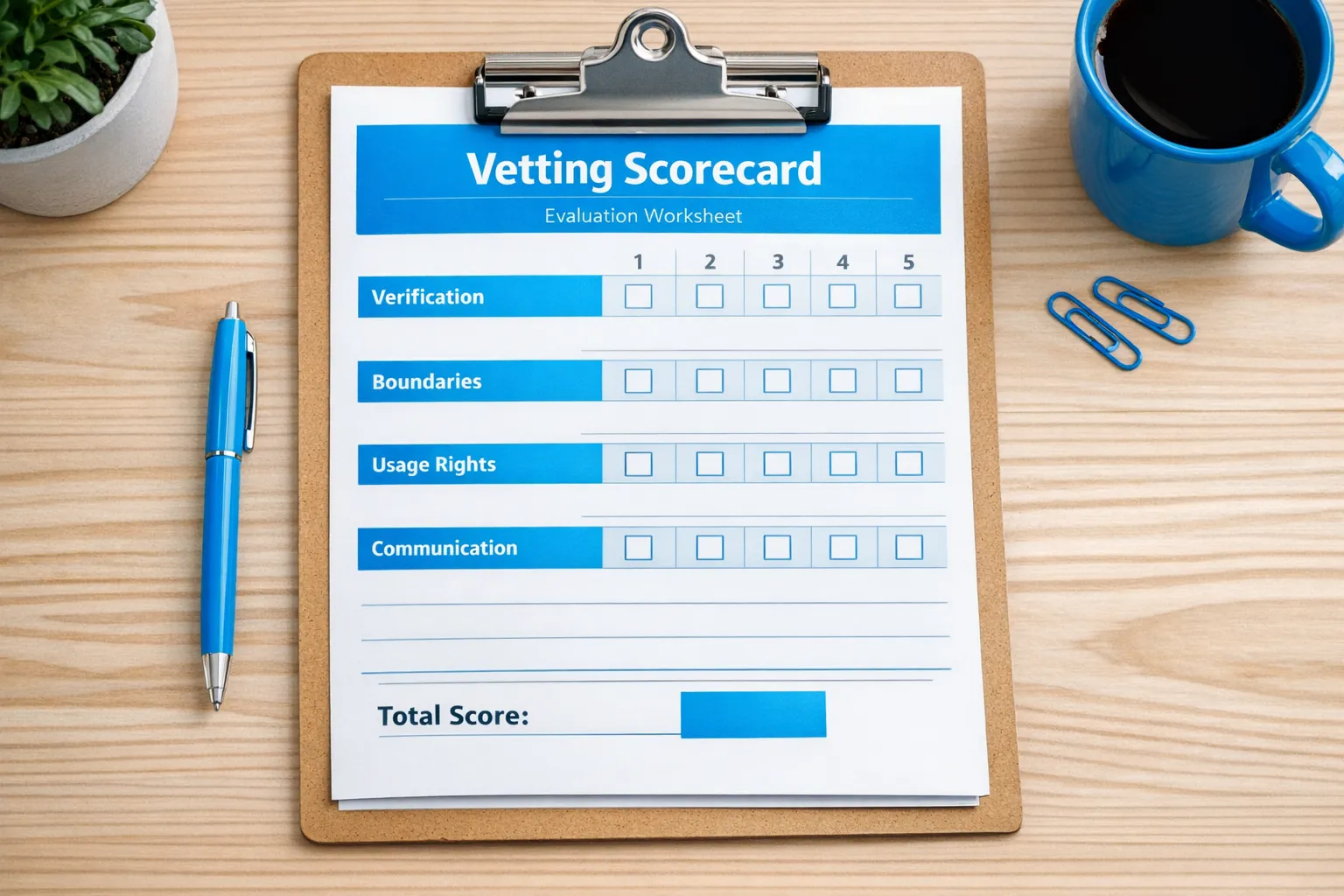
The “Vetting Scorecard” you can actually use
When you’re excited, it’s easy to ignore signals. A scorecard keeps you honest.
Rate each category 1 to 5 (1 = poor, 5 = excellent), then total it.
| Category | What “5” looks like | What “1” looks like |
|---|---|---|
| Identity verification | Willingly verifies with video + consistent handles | Dodges verification, inconsistent accounts |
| Communication | Clear, timely, organized | Vague, flaky, pushes urgency |
| Consent culture | Enthusiastic about boundaries and stop signals | Minimizes boundaries, jokes about consent |
| Business clarity | Clear deliverables, dates, posting plan | “We’ll figure it out later” |
| Usage rights maturity | Comfortable with written usage rules | Wants unlimited rights without discussion |
| Privacy awareness | Understands leaks, watermarking, no personal details | Posts reckless promos, overshares locations |
| Reputation | Other creators vouch, no public drama pattern | Constant drama, callout threads |
A practical rule: if they score low on consent culture or privacy awareness, it’s a no, even if everything else is great.
Copy/paste DM template to vet a potential collab partner
If you want to sound confident, clear, and not awkward, steal this:
Hi! I’m open to a collab if we’re a good fit. Quick questions so we don’t waste each other’s time:
- What kind of collab are you thinking (SFS, bundle swap, joint shoot, guest appearance)?
- What are your hard boundaries (on-camera and off-camera)?
- Are you comfortable doing a quick 5-second verification video (today’s date + “blue pineapple”)?
- How do you prefer to handle posting (each on our pages vs one page only), and do you have any rules on promo clips?
If that all matches, happy to do a quick 10-minute call and plan something fun.
You can change the verification phrase every time.
Red flags that are especially common in gay creator collabs
These show up a lot, and they cost creators money and peace.
“I need the raw files” pressure
Raw files mean maximum leverage for misuse. Only share what your agreement allows.
“No paperwork, we’re cool”
Being “cool” is not a business system. Written terms protect both of you.
Constant urgency
Rushing is a tactic. Real professionals can schedule.
Audience mismatch hidden by vanity metrics
Someone can have big views but low buyer intent. Tracking links and conversion checks matter.
“My manager handles it” but won’t disclose who chats or negotiates
If a third party is involved, you need transparency. If you’re evaluating any kind of management support for yourself, compare options calmly here: Working With an Agency vs Running OnlyFans Alone.
For scam patterns across the industry (fake growth, account takeovers, shady middlemen), this is worth reading once: OnlyFans Scam: How Agencies, Managers and Chatters Rob the Creators.
Leak protection: collabs increase exposure, so tighten your basics
Any time another person has access to content featuring you, your leak risk goes up.
Minimum protections:
- Watermark your content (even subtly)
- Avoid identifiable backgrounds (hotel signs, street names)
- Agree on what can be used for promo and where
If privacy is a major concern, you’ll also want to use platform tools like country blocking and tighten your promo footprint. This guide is a good baseline: How to Secretly Promote Your OnlyFans (Without Friends or Family Finding Out).

A realistic “green-light” process (so you don’t overthink)
If you want a simple workflow that still protects you:
Green-light stage 1 (online)
Verification + quick boundaries DM + basic usage agreement.
Green-light stage 2 (planning)
10-minute call, confirm deliverables, confirm posting plan, confirm money model.
Green-light stage 3 (shoot)
Clear stop signal, no pressure, and you both know what gets posted.
If any stage feels off, you pause. You don’t push through.
When it might be smarter to skip collabs (even if you want growth)
Collabs are not always the best lever.
Skip for now if:
- You’re struggling with leaks or privacy anxiety already
- Your DMs and PPV system is not optimized (collabs bring traffic, but you still have to convert it)
- You don’t have the emotional bandwidth for negotiation and coordination
In those cases, you’ll often get a better ROI from tightening your funnel, content cadence, and chat strategy first.
Want help coordinating growth without taking on collab risk alone?
If collabs feel high-stress because of privacy, leaks, or the time it takes to plan and negotiate, that’s a real bottleneck, not a personal failing.
Lookstars is an OnlyFans management agency that helps creators grow through multi-platform marketing, 24/7 fan chatting, strategic posting, and content leak protection, with no upfront costs and flexible contracts. If you want to scale while keeping stronger boundaries around your time and privacy, you can explore whether it’s a fit.
Ready to transform your career?
Join hundreds of creators already earning six figures with Lookstars Agency.
Share this article
Best OnlyFans Agency
Europe's Leading OnlyFans Management Agency.
100% Free Ebook
Get our guide and unlock the secrets to OnlyFans success.
100% Free Ebook
Get our guide and unlock the secrets to OnlyFans success.
Free Revenue Calculator & Profile Analyzer
Try them for freeContinue reading...
Am I Attractive Enough for an OnlyFans Agency? The Answer
Can You Ever Fully Delete Your OnlyFans Content? The Reality