OnlyFans for College Students Explained
College can be the first time you have real independence, real bills, and real pressure to “figure it out.” So it makes sense that a lot of students quietly ...
College can be the first time you have real independence, real bills, and real pressure to “figure it out.” So it makes sense that a lot of students quietly google “OnlyFans for college students” to see if it’s a smart side income, or a future regret.
This guide is here to be practical, not preachy. You’ll learn what’s different about running OnlyFans while you’re in school, how to reduce privacy risk, how to think about money and taxes, and a simple framework to decide whether to start now, wait, or get support.
First, the basics (and what’s different in college)
OnlyFans is a subscription platform where creators monetize content through subscriptions, tips, and pay-per-view (PPV) messages. Like any online business, it’s not just “posting.” The real work is:
- Content planning and creation
- Promotion (traffic from other platforms)
- DMs (where most upsells happen for many creators)
- Customer service, boundaries, and safety
- Basic business ops (payouts, receipts, taxes)
What changes when you’re a student is the risk-to-reward math:
- You’re more “discoverable” (campus social circles are tight)
- You have institutional rules (school codes, internships, scholarships, athletics, residency programs)
- Your schedule is non-negotiable (exams, clinicals, group work)
- Your living situation can expose you (roommates, dorm layouts, recognizable spaces)
None of that means “don’t do it.” It just means you need a more careful setup.
Age, legality, and school rules (don’t skip this)
OnlyFans requires creators to be 18+ and to complete identity verification. Policies can change, so always verify requirements in OnlyFans’ official documentation before you start.
Now the part students often miss: your school can have its own rules.
Some colleges and programs (especially those connected to licensing, clinical placements, or strict conduct codes) may have policies that affect what you can do publicly, how you can represent the school, or how “professionalism” is interpreted.
What to do before you post anything:
- Read your student handbook and program-specific code (nursing, teaching, athletics, ROTC, etc.)
- Check internship or placement agreements (some include morality clauses or social media terms)
- Decide your risk tolerance (private and anonymous is different from public and branded)
If you’re unsure, it can be worth getting legal advice for your specific situation.
Disclaimer: This is educational, not legal or tax advice. Policies and laws can change. Verify with official sources or a professional.
Privacy and anonymity: what actually helps (and what doesn’t)
If you’re a college student, privacy usually isn’t a preference, it’s a requirement.
What anonymity can realistically do
A strong anonymity setup can:
- Reduce the chance classmates casually connect your creator identity to your legal identity
- Reduce “algorithmic” discovery through reused usernames, photos, or contacts
- Reduce local exposure if you use platform tools like country blocking
What anonymity cannot guarantee
No tactic can promise you’ll never be found.
- Content can leak
- Someone can recognize your room, tattoos, voice, or background details
- Someone can share your page privately even if you block regions
If you want a deeper walkthrough, see: How to Secretly Promote Your OnlyFans (Without Friends or Family Finding Out).
A “college-safe” privacy setup (practical, not paranoid)
Here’s the setup that reduces risk without making you miserable:
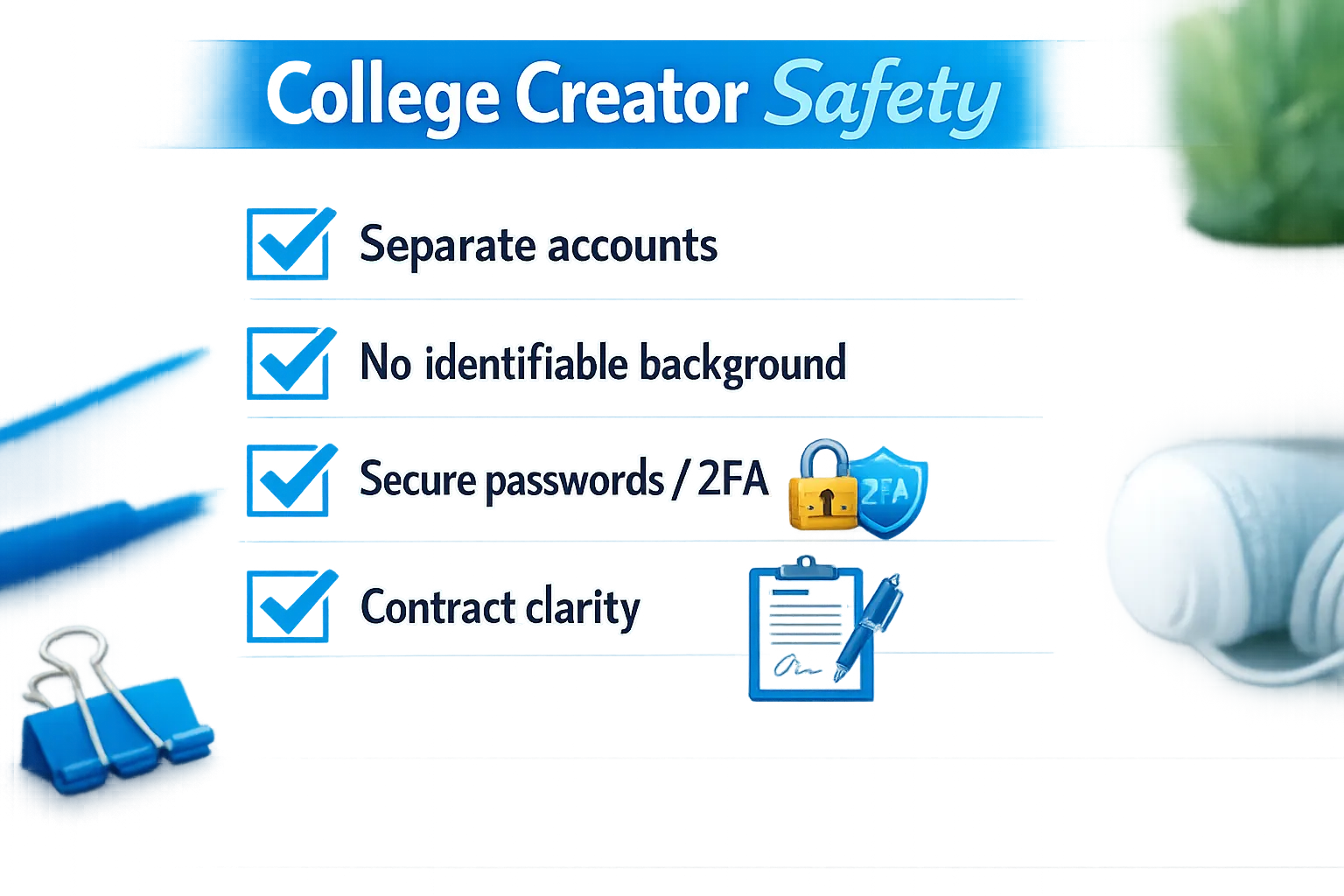
- Separate identity: new email, creator-only usernames, and no reuse of handles from your personal accounts.
- Location hygiene: avoid filming with anything that connects to campus (logos, dorm name tags, sports gear, unique campus views).
- Background control: a plain wall, curtain, or simple backdrop beats a cute dorm corner that everyone recognizes.
- Metadata awareness: photos can contain data (EXIF). Use settings/tools that strip metadata before posting anywhere.
- Watermarking: not perfect, but it helps discourage lazy reposts and makes takedown requests easier.
- Block features: if the platform offers region/country blocking, use it, but treat it as a layer, not a shield.

Managing DMs without failing your classes (the real bottleneck)
For many creators, the feed keeps people subscribed, but DMs drive PPV, customs, and tips. In college, DMs can also become the fastest path to burnout.
Here’s the truth: if you’re in lectures, labs, or clinicals, you can’t respond “right now” when a spender is in the mood to buy.
If you’re staying solo, consider a DM structure that protects your schedule:
The “office hours” approach
Pick DM windows that fit student life, for example:
- 30 minutes in the afternoon
- 60 minutes at night
- A longer session on weekends
Then set expectations in a pinned post or welcome message: you reply daily, but not 24/7.
If you want to get more strategic about selling in messages (without sounding desperate), read: OnlyFans Sexting Guide: Better Sexting With Your Subscribers.
Money: what you keep, what you owe, and what to plan for
OnlyFans takes a platform fee
OnlyFans has historically taken a percentage fee from creator earnings (commonly stated as 20%). Always confirm the current fee structure inside your creator dashboard or official documents.
Taxes are not optional
If you earn income, you generally need to track it and report it appropriately. In the US, many creators receive tax forms depending on thresholds and payment processing rules.
A simple habit can save you later panic: OnlyFans Taxes: Weekly Habit to Stay Organized.
For official US guidance, see the IRS Self-Employed Individuals Tax Center.
Scholarships and financial aid: a quiet “maybe” risk
Need-based aid is often tied to income. If your income changes, your aid package can change.
That doesn’t mean “OnlyFans will ruin your FAFSA.” It means: treat it like real income and ask the right people.
Practical move:
- If you rely on need-based aid, talk to your financial aid office about how added income could affect you (without oversharing details if you don’t want to).
Banking and privacy
Many students prefer to keep income separate from family visibility.
A good baseline is:
- A dedicated bank account for payouts
- A dedicated email for anything financial
- Clean bookkeeping from day one
Again, don’t attempt to evade identity verification or payment rules. Build a clean system you can defend.
Decision framework: should a college student start OnlyFans now?
Use this honest 5-part check. If you get stuck, that’s a signal.
1) Your “discovery tolerance”
Ask yourself: If a classmate finds it, can I live with that?
If the answer is “absolutely not,” your options are:
- Wait
- Choose a different income stream
- Commit to a strict anonymity niche and accept that it still isn’t zero-risk
2) Your time budget (in real hours)
If you can’t consistently give at least a few focused hours per week, your account may stall.
College-friendly minimums (realistic for many students):
- 1 content batch session per week (photos/videos)
- 3 to 7 promo sessions per week (short posts, replies, light networking)
- 4 to 7 DM sessions per week (even if short)
3) Your mental health and boundaries
OnlyFans can be empowering, and it can be emotionally intense.
Be honest about:
- Whether you can handle sexual attention without people-pleasing
- Whether you can say “no” without over-explaining
- Whether you’re using it to escape financial anxiety (which can push you into uncomfortable choices)
If you’re already struggling, consider talking to a counselor or trusted support first.
4) Your privacy setup quality
If you’re living with roommates, sharing walls, or filming in recognizable spaces, privacy isn’t just “settings.” It’s physical.
5) Your business goal (short-term cash vs long-term brand)
There’s a big difference between:
- “I need $300 for books this month”
- “I want to build a real creator business over 12 months”
Short-term pressure can cause rushed decisions, risky promotion, or weak boundaries.
Operating options (solo vs hiring help) with a college lens
A lot of college creators assume it’s either “solo” or “agency.” In reality, there’s a spectrum.
| Option | Best for | Biggest upside | Biggest tradeoff | College-specific note |
|---|---|---|---|---|
| Solo (DIY) | Strong self-starters with time | Full control, no revenue share | Slow learning curve, high workload | Hard during exams and clinicals |
| Hire a chatter (chat-only) | Good traffic but DM overwhelm | Faster replies, more upsells | Trust + brand voice risk | You still must manage promo/content |
| Full-service OnlyFans management agency | Creators who want to scale and protect privacy | Marketing + DMs + strategy + ops support | You give up some control and share revenue | Can protect grades by reducing day-to-day workload |
If you want the deeper breakdown, read: Working With an Agency vs Running OnlyFans Alone and OnlyFans Agency vs Chatter Services: What’s Better?.
A college-student “start smart” checklist (do this before launch)
If you want a clean launch, use this pre-flight checklist:
- Choose a stage name and usernames you can keep consistent across promo platforms
- Create separate email and creator-only social accounts
- Decide your boundaries (what you do, what you don’t do, what costs extra)
- Remove identifiable items from your filming area (school merch, dorm details)
- Create 2 weeks of content before you start promoting
- Draft a simple menu: subscription offer, PPV themes, custom rules, response times
- Set a weekly schedule that survives midterms
- Start a basic bookkeeping habit (income, expenses, receipts)
If you need help with the platform setup itself, see: How to Start, Create & Verify Your OnlyFans Account (Complete Beginner’s Guide).
Red flags: college students are often targeted by scams
New creators are a common target, and students can be even easier to pressure (because rent is due and you’re busy).
Be extra careful if someone:
- Promises guaranteed earnings
- Won’t get on a call
- Pushes you into long contracts with no exit
- Demands upfront fees before proving value
- Asks for full account access immediately, without clear security processes
Use these as your safety reads:
- 6 Red Flags to Watch Out for Before Signing with an OnlyFans Agency
- OnlyFans Scam: How Agencies, Managers and Chatters Rob the Creators
Frequently Asked Questions
Can a college student do OnlyFans anonymously? Yes, many creators reduce exposure with stage names, separate accounts, careful backgrounds, and privacy settings like country blocking. But anonymity is never guaranteed, so decide what level of discovery risk you can live with.
Will OnlyFans affect my financial aid? It can, depending on the type of aid and your overall income. Treat it like real income and ask your financial aid office how additional earnings could change your package.
How do I avoid classmates finding my OnlyFans? You can reduce the chance by keeping identities separate, avoiding recognizable dorm/campus details, using watermarks, and promoting on platforms that don’t connect to your real-life network. For a full playbook, read Lookstars’ guide on promoting anonymously.
How much time does OnlyFans take in college? It depends on your goals. A sustainable baseline often includes one weekly content batch session, short daily promo touches, and planned DM “office hours.” If DMs interrupt studying, your system needs tightening or support.
Should I join an OnlyFans management agency as a student? It can make sense if your bottleneck is time (DMs, posting consistency, promotion) and you’re serious about treating it like a business. It’s not a fit if you want full control, don’t want to share revenue, or aren’t ready to collaborate with a team.
Want help scaling (without losing your grades or your privacy)?
If you’re a college creator who’s serious about building this like a business, the fastest win is usually not “work harder,” it’s remove the bottlenecks that steal your time.
Lookstars is an OnlyFans management agency that supports creators with marketing and fan growth, 24/7 fan chatting (DM sales and PPV upsells), posting strategy, and privacy-focused support like leak monitoring and takedowns, plus country blocking and security setup. They also emphasize no upfront costs, weekly payouts, and flexible cancel-anytime contracts.
If that sounds like the kind of structure that would actually fit your student schedule, you can learn more or apply here: Lookstars Agency.


Ready to transform your career?
Join hundreds of creators already earning six figures with Lookstars Agency.
Share this article
Best OnlyFans Agency
Europe's Leading OnlyFans Management Agency.
100% Free Ebook
Get our guide and unlock the secrets to OnlyFans success.
100% Free Ebook
Get our guide and unlock the secrets to OnlyFans success.
Free Revenue Calculator & Profile Analyzer
Try them for freeContinue reading...
Am I Attractive Enough for an OnlyFans Agency? The Answer
Can You Ever Fully Delete Your OnlyFans Content? The Reality