OnlyFans Earnings Explained: Gross vs Net Income
Most creators don’t get “confused about money” on OnlyFans because they’re bad at business. They get confused because platforms, payouts, refunds, agency spl...
Most creators don’t get “confused about money” on OnlyFans because they’re bad at business. They get confused because platforms, payouts, refunds, agency splits, and taxes all use different numbers.
So you’ll see something like “$8,000 this month” in one place, but your bank deposit is way lower. That gap is usually explainable, and once you understand it, you can price smarter, negotiate safer, and plan your real take-home.
The 4 numbers you need to separate (or you’ll always feel broke)
When creators say “I make $X on OnlyFans,” they could mean four different things.
| Term | What it means (plain English) | What it’s used for | Common mistake |
|---|---|---|---|
| Gross sales (top-line) | Total customer spend before any cuts (subs, PPV, tips, etc.) | Measuring demand and marketing performance | Assuming it’s what you’ll keep |
| Net on platform | What’s left after the platform’s fee (OnlyFans takes a percentage) | Estimating what’s available for payouts | Forgetting refunds and chargebacks |
| Payouts received | Money that actually lands in your bank in a given period | Cash flow planning | Confusing payout timing with earnings timing |
| Net profit (real income) | What you keep after business expenses (and later, taxes) | Your real “salary” from OF | Not tracking expenses, then getting surprised at tax time |
OnlyFans’ fee is widely cited as 20% of earnings (policies can change, so it’s always smart to verify in official documentation like the OnlyFans Help Center).
The OnlyFans earnings “waterfall” (gross to net, step by step)
If you want your numbers to make sense, think in a waterfall. Your money moves through stages.
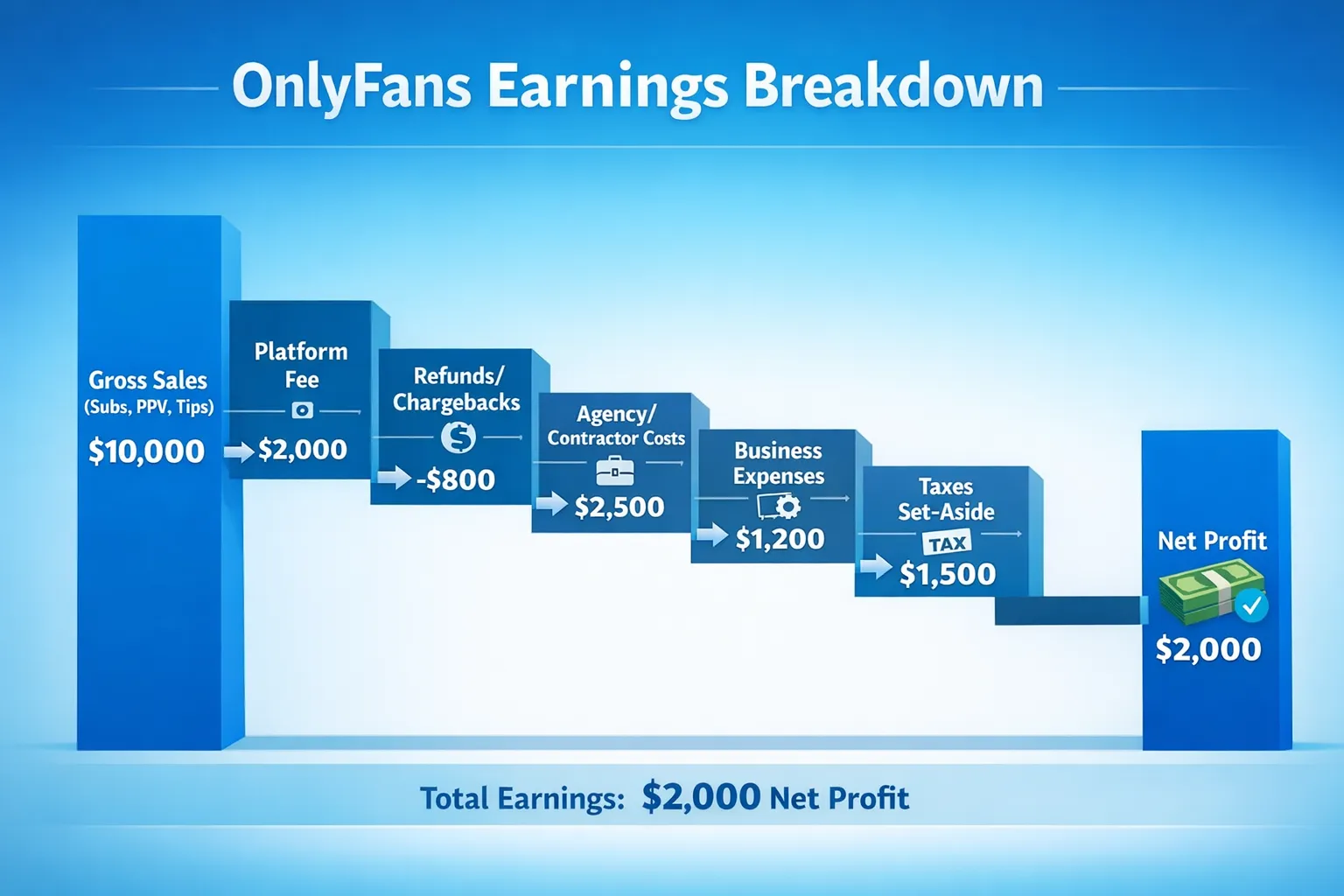
Step 1: Gross sales
This is the total fans spend:
- Subscriptions
- Pay-per-view messages
- Tips
- Livestream related spend (if you use it)
This number is great for measuring what your content and sales system can generate.
Step 2: Platform fee
The platform cut comes out next. That’s why a month that “looks like” $5,000 in sales never equals $5,000 in your pocket.
Step 3: Refunds, chargebacks, and adjustments
Even if you did everything right, you can still see deductions. You want to understand:
- Refunds (when a fan is refunded)
- Chargebacks (when a payment is reversed via the card/bank process)
You do not need to panic when you see adjustments, but you do need to track them so your “net” is accurate.
Step 4: Team costs (optional, but common)
This is where creators can get burned in negotiations.
If you work with:
- an agency,
- a manager,
- a chatter team,
- editors,
- a social media assistant,
…you need to know which number your split is based on (gross vs net), and whether expenses are deducted before or after the split.
Step 5: Business expenses
This is everything you spend to produce, protect, and promote.
A few common categories creators forget to include in “real income”:
- Equipment and upgrades
- Editing tools and storage
- Paid promo, shoutouts, or creators you outsource to
- Content protection and takedowns
- Props, sets, travel, subscriptions to tools
If you want a creator-friendly way to organize this, Lookstars has a solid bookkeeping routine guide here: OnlyFans Taxes: Weekly Habit to Stay Organized.
Step 6: Taxes set-aside
Taxes vary by country and situation. The key is that taxes are paid on profit, not just “what hit your bank this week.”
This is educational, not legal or tax advice. Policies and laws can change. Verify with official sources or a professional.
For a practical tracking approach, this guide can help: OnlyFans 1099 Taxes: What Creators Should Track.
A realistic example (why “I made $10k” can mean 3 different things)
Let’s do a simple hypothetical month.
You generate $10,000 in gross sales.
From there, your net profit depends on variables like:
- platform fees
- refunds/chargebacks
- whether you pay an agency or contractors
- your monthly operating expenses
- your tax rate and set-aside habits
Two creators can have the same $10k gross month and end up with totally different take-home.
Scenario A: “Solo, lean expenses”
If you run everything yourself and your expenses are minimal, your net profit could be relatively close to your platform net (minus the tax set-aside).
Scenario B: “Scaling with help”
If you outsource DMs, content planning, and growth, you might keep less short-term, but you may be buying back time and consistency that helps you scale.
The point is not that one is better. The point is to pick intentionally, and to calculate using the same definitions every month.
Gross vs net matters most when you’re hiring help (agency, manager, chatters)
If you’re considering an OnlyFans management agency, the gross vs net question is not a detail. It is the deal.
Here’s what you’re trying to avoid:
- You hear “we take X%,” but you don’t know of what.
- You assume it’s after fees, but it’s calculated before fees.
- You budget based on gross, but your business runs on net.
The 3 most common ways splits are calculated
Agencies and teams can structure things differently, so don’t assume.
| Split style | What the percentage is based on | Why it can be good | What to watch |
|---|---|---|---|
| % of gross sales | Before platform fee and before adjustments | Simple to calculate | You may feel “double-cut” (platform plus split) |
| % of net on platform | After platform fee, usually before external expenses | Often feels fairer | Still clarify refunds/chargebacks handling |
| Net profit after expenses | After fees, adjustments, and approved expenses | Aligns incentives | Requires high trust and clean bookkeeping |
There’s no universally “right” model. A fair arrangement depends on what’s included (growth, 24/7 chat, leak protection, editing, posting, strategy) and how transparent the reporting is.
If you’re still deciding whether to outsource at all, this comparison is a helpful starting point: Working With an Agency vs Running OnlyFans Alone.
The questions to ask (copy/paste) so you don’t get trapped in vague math
Use this script on your next call with an agency, manager, or chatter service. It’s designed to force clarity without sounding confrontational.
Gross vs net clarification
- “Is your percentage calculated on gross sales or net after platform fees?”
- “How do you handle refunds and chargebacks in reporting and in the split?”
- “Do you calculate your split based on the month the sale happened, or the month the payout clears?”
Expense rules
- “Are there any extra costs deducted before payouts (tools, promo, editing, DMCA)?”
- “If there’s ad spend or paid promotion, who approves it, and who pays it?”
- “Can I get a monthly breakdown showing earnings, adjustments, expenses, and the final amount?”
Access, security, and brand voice
- “Who will be chatting with fans, and what training and boundaries do you use?”
- “What security steps do you require (2FA, device rules, access logs)?”
If you want more safety-focused vetting, pair the questions above with this guide: 6 Red Flags to Watch Out for Before Signing with an OnlyFans Agency.
What to track monthly (so you always know your real income)
Creators who feel financially calm are rarely the ones making the most. They’re the ones tracking the right numbers.
Here’s a simple monthly dashboard you can keep in Notes, Notion, or a spreadsheet.
| Category | What to record | Why it matters |
|---|---|---|
| Gross sales | Total sales by source (subs, PPV, tips) | Shows what’s driving revenue |
| Platform fees | Total fees deducted | Helps you forecast net |
| Adjustments | Refunds and chargebacks | Prevents “mystery losses” |
| Payouts received | Bank deposits by date | Cash flow and bill planning |
| Outsourcing | Agency split and contractor payments | True operating cost |
| Expenses | Tools, equipment, promo, protection | Net profit accuracy |
| Tax set-aside | Amount moved to a tax bucket | Reduces tax panic |
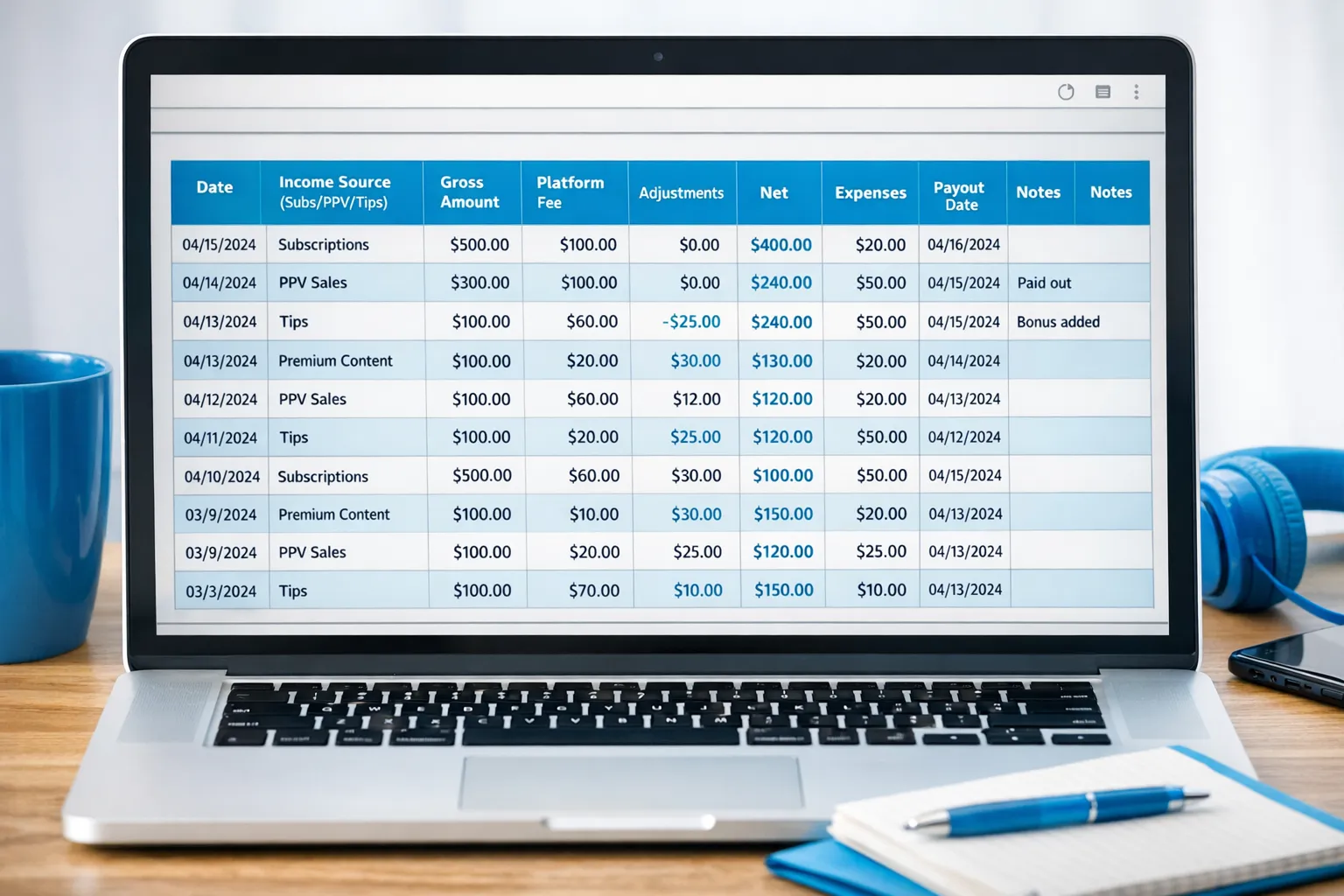
If you’re not sure what expenses you should even be tracking, this guide covers common categories: Top Tax Deductions OnlyFans Creators Often Miss.
Quick decision framework: optimize for the bottleneck, not the headline number
If your goal is a higher net income (not just a bigger gross screenshot), ask yourself which bottleneck is actually holding you back.
If you’re stuck around $1k to $3k per month
A common pattern is: content is fine, DMs convert okay, but traffic is inconsistent.
Your “net” improves most when you fix:
- top-of-funnel traffic that consistently brings new fans
- conversion points (bio, pinned posts, welcome message, offer structure)
If you’re at $3k to $10k per month and overwhelmed
Another common pattern is: traffic is working, but you can’t keep up with DMs, follow-ups, PPV cadence, and retention.
Your net can drop even as gross rises, simply because you are leaking money in the form of:
- slow response times
- missed upsells
- inconsistent posting
- burnout weeks where promo stops
This is where some creators decide to outsource.
If you’re already established and privacy is your biggest fear
Your “net” is not just money. It’s also risk.
Leak monitoring, takedowns, country blocking, and security setup can protect your long-term earning ability, even if they don’t show up as “more gross” immediately.
Where Lookstars fits (and who it’s not for)
Lookstars positions as a full-service OnlyFans management agency focused on marketing, fan engagement, privacy protection, and business operations. They highlight no upfront costs, weekly payouts, and flexible cancel-anytime contracts, which can reduce risk for creators who are cautious about being locked in.
You can learn more about what they do in their own breakdown here: What can an OnlyFans Manager really do for you in 2025? and a decision-focused guide here: When to Hire an OnlyFans Management Agency: 5 Brutal Truths Every Creator Needs to Hear.
Who this is generally not for:
- creators who want to keep 100% control of all messaging and operations
- creators who are still experimenting and not ready for a structured growth plan
- anyone uncomfortable sharing account access, even with security processes
The best next step, if you’re considering any agency, is to use the gross vs net questions above and request a sample reporting breakdown before you sign.
The bottom line
“Gross vs net” is not accounting jargon. It’s the difference between feeling like you’re thriving and feeling like your money disappears.
If you do one thing today, do this: write down your four numbers (gross sales, net on platform, payouts received, net profit) and make sure every person you work with uses the same definitions. That one habit makes pricing decisions, outsourcing decisions, and tax planning dramatically less stressful.



Ready to transform your career?
Join hundreds of creators already earning six figures with Lookstars Agency.
Share this article
Best OnlyFans Agency
Europe's Leading OnlyFans Management Agency.

100% Free Ebook
Get our guide and unlock the secrets to OnlyFans success.
100% Free Ebook
Get our guide and unlock the secrets to OnlyFans success.
Free Revenue Calculator & Profile Analyzer
Try them for freeContinue reading...

Am I Attractive Enough for an OnlyFans Agency? The Answer

Can You Ever Fully Delete Your OnlyFans Content? The Reality