OnlyFans Agency Scams vs Legit Agencies: How to Tell the Difference
Most “OnlyFans agency scams” don’t look like scams at first. . . They look like a confident DM, a clean website, a promise to “handle everything,” and screen...
Most “OnlyFans agency scams” don’t look like scams at first.
They look like a confident DM, a clean website, a promise to “handle everything,” and screenshots that may or may not be real.
The problem is that when the “agency” is shady, the downside is brutal: your payouts, your content, your account access, your identity, and your peace of mind.
This guide is a creator-first checklist to help you tell OnlyFans agency scams vs legit agencies apart, ask the right questions before signing, and protect yourself even if you decide to outsource.
(Educational only, not legal or tax advice. Policies and laws can change. Verify details in official docs and with a professional if you’re unsure.)
First: What exactly are you hiring?
A lot of creators get trapped because the offer is vague. Before you evaluate any team, name what you are actually outsourcing.
Here’s how most “management” arrangements break down in practice:
| Option | What they do | Biggest risk | Best for |
|---|---|---|---|
| Solo (DIY) | You do content, promo, DMs, pricing | Burnout and slow iteration | New creators learning basics, creators who want maximum control |
| Chatter-only | A team sells in DMs/PPV/customs | Brand voice mismatch, boundary issues, compliance mistakes | Creators with traffic but low DM conversion |
| Marketing-only | Traffic strategy and posting on socials | Low ROI if your funnel and DMs aren’t ready | Creators with great content and strong conversion but low traffic |
| Full-service agency | Content planning, marketing, DMs, operations, leak protection | Biggest access, biggest dependency | Creators scaling and willing to delegate operations |
If you’re still deciding whether an agency makes sense at all, these two internal reads help you benchmark expectations:
- Are OnlyFans Agencies Worth It? A Detailed Review
- What can an OnlyFans manager really do for you in 2025?
Why scams are so common in the OnlyFans agency space
This industry has three conditions scammers love:
- High emotion + urgency (you want relief from burnout or a quick fix for a plateau).
- Information imbalance (most creators don’t know what “good” looks like operationally).
- Hard-to-verify proof (screenshots, dashboards, “client results” without context).
A legit agency exists to build systems. A scam exists to capture access, money, or both.
The fastest way to spot the difference: follow the incentives
When you’re not sure, ask yourself one question:
Do they make money by building your business, or by locking you in?
- A legit agency tends to be confident in retention because results and experience keep clients.
- A scam leans on pressure, secrecy, and contracts that are hard to exit.
That lens alone filters out a surprising number of “too good to be true” offers.
OnlyFans agency scams: 11 patterns you should treat as danger
You don’t need all 11 to walk away. Two or three is usually enough.
1) They refuse a real call (or won’t show faces or names)
Creators get told “we’re too busy” or “privacy” as an excuse.
Privacy matters, yes. But basic accountability matters more when someone will access your income streams. A legit team can do at least one of these:
- A video call with leadership
- A call with a current creator (reference)
- A verifiable business identity (company details, contracts, consistent digital footprint)
2) They promise guaranteed income
No one can guarantee your earnings, because results depend on content consistency, niche, traffic sources, conversion, retention, seasonality, and platform changes.
A legit agency talks in process and inputs, not guarantees.
3) They push you to move money “off-platform” or use weird payment methods
If someone pressures you to accept payments in a way that feels sketchy, pause.
Even when something sounds convenient, it can create tax, chargeback, or compliance risk. If you need a baseline, stick to what the platform supports and what you can document cleanly.
4) “We need your login and 2FA, right now” (and they don’t discuss safe access)
Full-service management may need account access. That part alone isn’t a scam.
The red flag is when they:
- Ask for full access immediately
- Don’t offer a secure process
- Don’t explain who will access what, and why
A legit operator will talk about access levels, device security, and what happens if you end the partnership.
5) Fake “leak protection” claims
Content theft is real, but it’s not magic.
If they say they can “stop all leaks forever,” that’s not realistic. What you want to hear instead is something like: monitoring, takedown workflows, documentation, and expectations management.
If you care about privacy and anonymity, this internal guide is also worth reading:
6) Hidden fees disguised as “tools,” “training,” or “setup”
Common scam move: they advertise “management,” then add surprise charges.
Ask for a written, itemized list of costs. If the pricing changes after you sign, you want to know exactly when and how.
7) Long contracts with no clean exit
A legit agency can have a term. But if there’s no fair exit, or there’s a huge penalty for leaving, that’s a control play.
If you want a practical reference point, read:
8) They won’t define what success looks like (or what they’re accountable for)
“Growth” is not a deliverable.
A legit agency can define measurable operational outputs, for example:
- DM response coverage windows
- Posting cadence plans
- Promotion channels and testing cycles
- Reporting frequency and what’s included
9) They use tactics that could get your account restricted
If someone suggests spammy promotion, stolen content, misleading advertising, or anything that feels like it could violate platform rules, assume the risk will land on you.
A legit partner treats compliance as part of the job.
10) They dodge the “who is chatting as me?” question
This matters for boundaries, safety, and brand.
If the answer is vague, or they refuse to explain training, tone, and guardrails, it’s not safe.
11) They isolate you
A classic pattern is making you feel like you can’t talk to anyone else:
- “Don’t ask other creators, they’ll steal your niche.”
- “You can’t tell anyone you’re working with us.”
Confidentiality around strategy is one thing. Isolation is another.
Legit OnlyFans agencies: what “green flags” look like in real life
A legit OnlyFans management agency doesn’t just sell hype. It sells clarity.
Here are green flags that usually show up together:
Transparent scope (what they do, what you still own)
They should be able to say:
- What they manage (marketing, DMs, pricing, posting)
- What you control (boundaries, content themes, face/no-face decisions, personal limits)
- What they will never do (for example, crossing your consent or breaking rules)
Proof that isn’t just screenshots
Screenshots can be edited. Better proof includes:
- A process walkthrough (how they grow accounts)
- Case studies with context (starting point, niche, timeline, what changed)
- References you can speak to (even if anonymized)
Secure access and offboarding
A legit team will discuss:
- How passwords are stored (and who has access)
- How 2FA is handled
- How access is removed when you leave
- What happens to files, captions, and content calendars after termination
Reporting that matches the work
If they claim analytics-driven growth, they should be able to show you what they track.
For example, tracking links are one practical way to validate promotion efforts:
Cost structures: what’s “normal,” and what should make you pause
You’ll see different pricing models. None is automatically good or bad, but each changes incentives.
| Pricing model | How it works | Why creators like it | Where scams hide |
|---|---|---|---|
| Revenue share | Agency takes a percentage of revenue (sometimes described as 30 to 50% in the market) | Low or no upfront cost | “Percentage” defined vaguely (gross vs net), extra fees stacked on top |
| Fixed monthly fee | You pay a flat amount for services | Predictable cost | Agency has less incentive to push performance unless terms are clear |
| Hybrid | Smaller fixed fee + smaller percentage | Balanced incentives | Can get complicated, watch for hidden add-ons |
Two contract definitions you must clarify:
- Gross vs net: Is their cut calculated before or after platform fees, chargebacks/refunds, editing costs, paid ads, and payouts to chatters?
- “Expenses”: What counts as an expense, who approves it, and is there a cap?
If they can’t explain this in plain English, don’t sign.
A simple decision framework: agency vs solo vs “outsource one piece”
Instead of asking “Do I need an agency?”, ask: Where is my bottleneck?
If you’re under $500 to $1k/month
You may get more ROI from learning fundamentals first: niche clarity, content rhythm, promo reps, and pricing tests.
A manager can help, but you need enough consistent content output to give the system something to scale.
If you’re around $2k/month and stuck
This is the classic plateau:
- You post consistently, but traffic is flat
- Your DMs convert, but you can’t keep up
- Your page is “fine,” but not optimized
This is where marketing systems and DM coverage often create a step-change, assuming you keep content consistent.
If you’re $5k+/month and overwhelmed
At this level, outsourcing is often about:
- Protecting your time and mental health
- Increasing consistency (posting, promo, DM follow-ups)
- Expanding to other platforms without adding chaos
If your main problem is burnout and admin overload, full-service help can make sense, but only if the agency is legit.
For more context on timing, see:
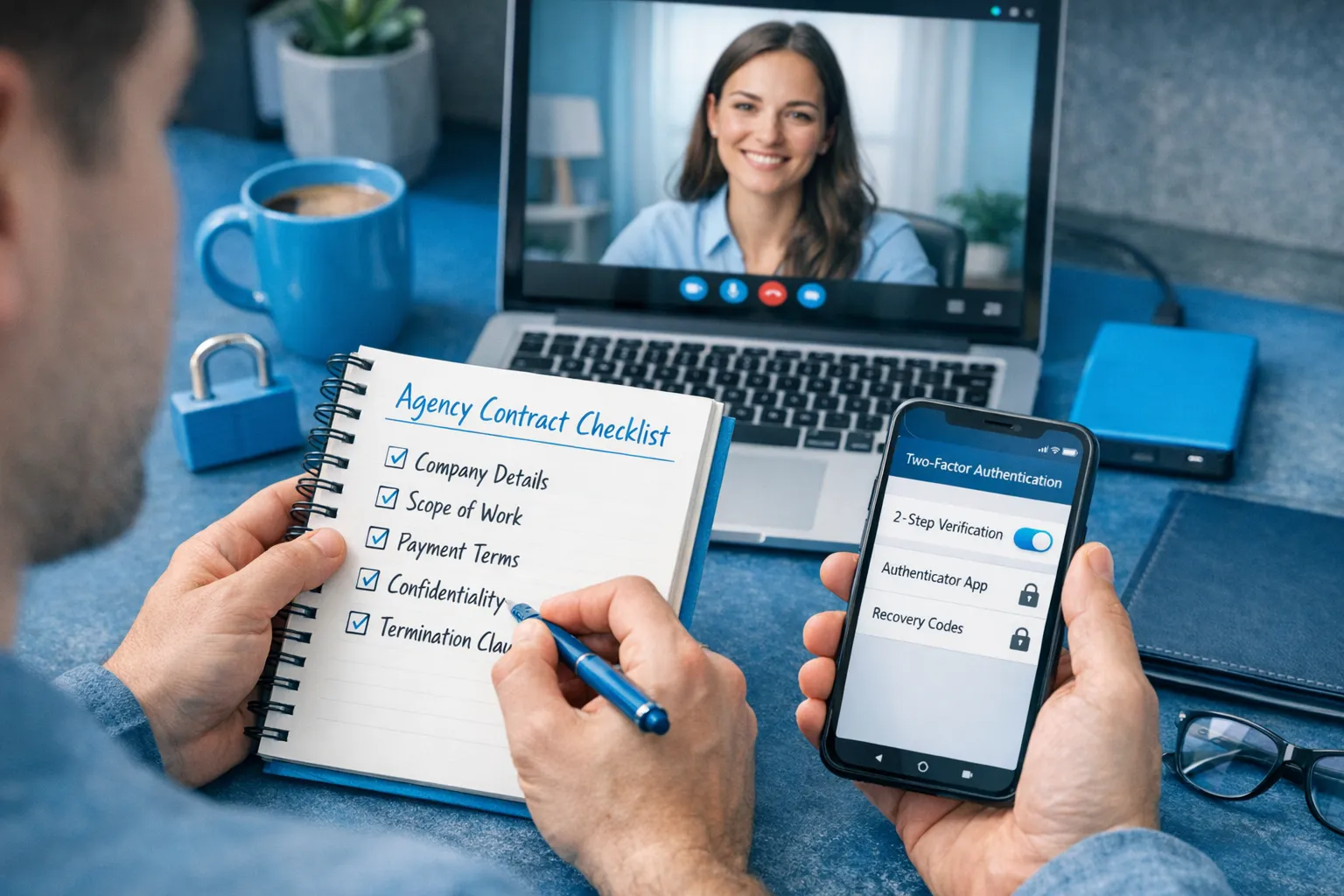
The 48-hour vetting protocol (use this before you give anyone access)
You don’t need weeks of investigation. You need a structured check.
| Step | What you do | What you’re looking for |
|---|---|---|
| 1) Identity check | Verify who you’re speaking to (names, business presence, consistent history) | Basic legitimacy, no disappearing act |
| 2) Operations call | Ask them to walk you through exactly how they run DMs, promo, and reporting | Clarity, not vague “we handle everything” |
| 3) Reference check | Speak to at least one current or past creator (even anonymously) | Consistent story, no weird evasiveness |
| 4) Contract review | Read everything, ask questions, request edits | Fair exit terms, clear definitions |
| 5) Security plan | Agree on access rules and offboarding in writing | You keep control, even when delegating |
If they pressure you to skip steps, treat that pressure as information.
Questions to ask before signing (copy/paste)
Use these questions verbatim. A legit agency will not be offended.
About results and strategy
- “What’s your plan for my first 30 days, week by week?”
- “What do you need from me to make this work (content volume, promo content, availability)?”
- “How do you decide what to test first: traffic, conversion, or retention?”
About DMs and chatters
- “Who will be chatting as me, and how are they trained?”
- “What boundaries do you follow (topics, tone, what you won’t say)?”
- “How do you handle chargebacks, angry fans, and compliance-sensitive requests?”
About money
- “Is your percentage based on gross or net, and what exactly is included/excluded?”
- “Are there any setup costs, software costs, or add-on fees?”
- “How often are payouts and reporting provided?”
About access, security, and ownership
- “What access do you need, and can we limit it?”
- “What happens to my accounts, content, and data if I leave?”
- “Do I keep ownership of my content and my brand assets?”
About the contract
- “What is the cancellation process, and what notice is required?”
- “Is there exclusivity, and if yes, what does it restrict?”
- “Can we add a clause that I can terminate immediately if safety or compliance is violated?”
Contract clauses creators overlook (and scammers love)
You don’t need to become a lawyer. You just need to notice the clauses that take away your power.
| Clause area | What you want | What you should avoid |
|---|---|---|
| Term and exit | Cancel-anytime, or a short term with a clean exit | Long lock-ins, big penalties, unclear termination |
| Revenue definition | Clear gross vs net, clear expense approvals | “We take X%” with no definition |
| Account access | Written access rules and offboarding | “Agency owns the account” language |
| Content ownership | You retain IP and usage rights | Agency claims rights to reuse/sell your content |
| Privacy and confidentiality | Mutual confidentiality, clear data handling | Clauses that silence you from warning others about abuse |
| Compliance responsibility | Shared compliance standards | Anything pushing you to break platform rules |
If anything feels unclear, ask for edits. A legit agency negotiates.
If you think you’re already dealing with a scam
If you’ve already shared logins or you feel that “uh oh” in your stomach, focus on containment.
- Change passwords immediately and update your email password too.
- Enable (or re-secure) two-factor authentication.
- Remove unknown devices and revoke connected sessions where possible.
- Document everything: chats, payment requests, contracts, threats, screenshots.
- If money is involved, consider speaking to a legal professional in your jurisdiction.
You can also read Lookstars’ deeper breakdown of scam patterns here:
Where Lookstars fits (and when it doesn’t)
Not every creator needs full-service management, and not every creator is a fit for every agency.
Based on Lookstars’ published offer, they emphasize:
- Marketing and fan growth (multi-platform strategy + analytics)
- 24/7 fan chatting (DM sales, PPV/custom upsells)
- Strategic posting management (content calendar, timing, offers)
- Content leak protection (monitoring + DMCA takedowns)
- Privacy setup (including country blocking and security setup)
- No upfront costs, flexible cancel-anytime contracts, weekly payouts
If you’re considering professional help, you can compare what you need against what management can realistically handle in:
Frequently Asked Questions
Are OnlyFans agencies legit, or are they all scams? Some agencies are legit and operate like real marketing and operations teams. Others are scams or poorly run. The safest approach is a structured vetting process plus a contract you fully understand.
What’s the biggest red flag when choosing an OnlyFans agency? Pressure and secrecy. If they rush you, refuse a call, won’t define pricing clearly (gross vs net), or won’t explain who is chatting as you, treat it as high risk.
Is giving an agency my OnlyFans login always unsafe? Not always, but it increases risk. If you choose to share access, do it with strict security rules, written offboarding terms, and transparency about who has access and why.
How do agencies usually get paid? Common models include revenue share (a percentage), fixed monthly fees, or hybrid structures. What matters most is the exact definition of revenue, any added expenses, and whether you can exit fairly.
Can a legit agency protect me from leaks completely? No one can realistically promise “no leaks ever.” Legit leak protection is about monitoring, takedown workflows, documentation, and reducing exposure, not making absolute guarantees.
Want a legit second opinion on an offer you received?
If you’re talking to an agency and something feels off, trust that instinct, then verify.
You can also apply to work with Lookstars and see what a transparent onboarding process looks like (scope, expectations, and fit before anything else):



Ready to transform your career?
Join hundreds of creators already earning six figures with Lookstars Agency.
Share this article
Best OnlyFans Agency
Europe's Leading OnlyFans Management Agency.
100% Free Ebook
Get our guide and unlock the secrets to OnlyFans success.
100% Free Ebook
Get our guide and unlock the secrets to OnlyFans success.
Free Revenue Calculator & Profile Analyzer
Try them for freeContinue reading...
Am I Attractive Enough for an OnlyFans Agency? The Answer
Can You Ever Fully Delete Your OnlyFans Content? The Reality