Onlyfans Agency Pricing & Commission in 2026: The Honest Guide
Most creators don’t lose money with an OnlyFans agency because “agencies are bad.” They lose money because they didn’t understand the pricing math (what comm...
Most creators don’t lose money with an OnlyFans agency because “agencies are bad.” They lose money because they didn’t understand the pricing math (what commission is calculated on, what’s included, and what extra costs can show up later).
This guide breaks down OnlyFans agency pricing & commission in 2026 in plain English, with the exact questions to ask before you sign anything.
Disclaimer: This is educational content, not legal, financial, or tax advice. Policies and laws can change, so verify terms in writing and consult a qualified professional for your situation.
Start with the baseline: OnlyFans takes 20%
Before we even talk about an agency’s cut, remember that OnlyFans charges a platform fee (commonly cited as 20%). That means your “$10,000 month” is not automatically $10,000 in your pocket.
The simplest way to think about it:
- Gross revenue: what fans spend (subs + tips + PPV)
- Platform fee: what OnlyFans keeps
- Net (after platform): what’s left before your other business costs
Why it matters: some agencies calculate commission on gross, others on net. That single detail can change your take-home a lot.
The 5 agency pricing models you’ll see in 2026
There’s no one “standard” commission across the industry. What you’ll see is a set of common structures, each with tradeoffs.
| Pricing model | How it works | Best for | Main risks / watchouts |
|---|---|---|---|
| Revenue share (commission) | Agency takes a % of revenue (make sure you define gross vs net) | Creators who want full support without paying cash upfront | Confusing definitions, hidden add-ons, long lock-ins |
| Fixed monthly retainer | You pay a set fee each month for defined services | Established creators who want predictable costs | Paying even in slow months, scope creep |
| Hybrid (retainer + smaller %) | Base fee plus a reduced commission | Creators scaling with paid promo or multiple platforms | Can be expensive if both pieces are high |
| Performance-based (bonus tiers) | Base fee or small % plus bonuses for clear milestones | Creators who want aligned incentives | “Milestones” can be defined in shady ways (vanity metrics) |
| A la carte | You pay for specific services (chatting, leak takedowns, editing, promo) | Creators who know their exact bottleneck | Costs add up fast, coordination burden stays on you |
A quick reality check: if you’re comparing offers, don’t ask “What’s your commission?” first. Ask:
“Commission on what number, for which services, with what extra costs, and what exit terms?”
What “commission” really includes (and what it often doesn’t)
A fair commission can be totally worth it if it replaces real work and produces measurable improvement. The problem is when commission is treated like a magic word that covers everything.
In 2026, pricing confusion usually comes from these four areas.
1) Gross vs net (the most important line in the contract)
Ask for a one-sentence definition you can paste into the agreement:
- Gross could mean: total fan spend before platform fee
- Net could mean: after platform fee, before other expenses
Also clarify whether “revenue” includes:
- tips
- PPV
- renewals
- chargebacks/refunds (and how those are handled)
2) What services are included vs billed separately
Two agencies can both charge “a commission” but deliver totally different scope.
Common bundles include:
- OnlyFans marketing and fan growth
- 24/7 DM chatting and sales systems
- posting strategy and content calendar
- leak monitoring, takedowns, DMCA-style processes
- privacy setup like country blocking
- operations and admin (payout organization, planning, etc.)
If you’re evaluating full management, it’s smart to compare it to the workload of going solo. (If you haven’t yet, read Working With an Agency vs Running OnlyFans Alone.)
3) “Pass-through” costs (ads, creators-for-hire, tools)
Even if an agency doesn’t charge upfront, you may still choose to spend money on growth.
Typical pass-through costs include:
- paid promo or traffic campaigns
- editing or filming support (if outsourced)
- software and tools
- content protection services
A legit setup is transparent: you approve spend before it happens, you can see receipts, and it’s clear whether those costs come out before or after commission is calculated.
4) Payment flow and control (who gets paid first?)
This is less “pricing,” more “power.” It still impacts your financial safety.
You want crystal clarity on:
- where money is paid out (your account vs agency-controlled)
- payout timing
- what happens if you terminate
If someone insists they must control your payouts to “make the system work,” slow down and do deeper due diligence.
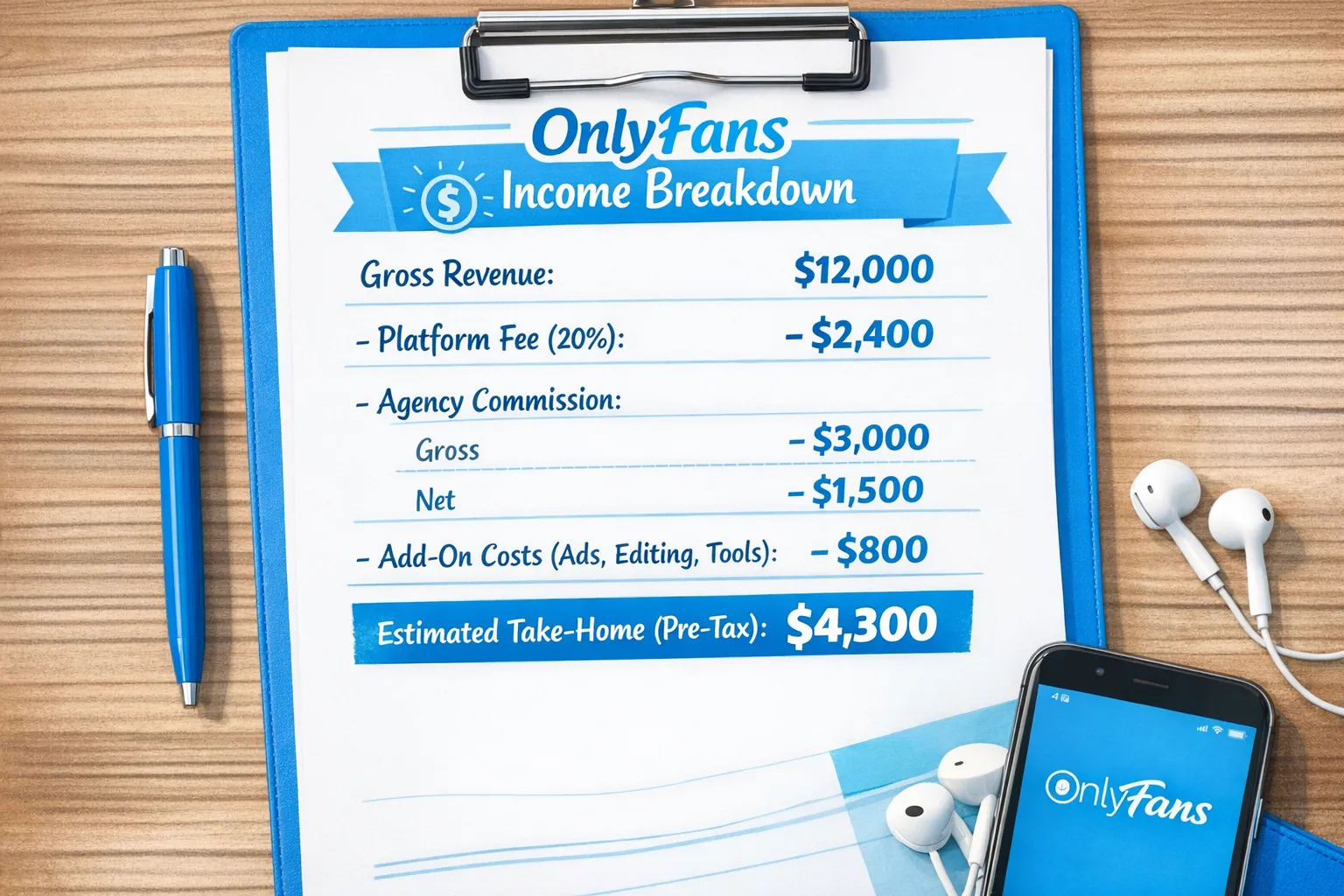
The real take-home calculator (use this before you sign)
Here’s the cleanest way to compute your true cost, no matter what model you’re offered.
| Step | What to calculate | Simple formula |
|---|---|---|
| 1 | Monthly gross | Subs + tips + PPV |
| 2 | After platform fee | Gross minus platform fee |
| 3 | Agency fee base | % of gross or % of net (define it) |
| 4 | Add pass-through costs | Ads + contractors + tools (approved) |
| 5 | Your estimated take-home (pre-tax) | After platform fee minus agency fee minus pass-through costs |
A realistic comparison example (illustrative numbers)
Let’s say your fans spend $10,000 in a month.
- After the platform fee, you have $8,000 left (assuming a 20% platform fee).
Now compare how the same “30% commission” can mean different things:
- 30% of gross: 30% of $10,000 = $3,000
- 30% of net (after platform): 30% of $8,000 = $2,400
That’s a $600 difference on one month, from one definition.
This is why you want the contract to define the base in plain language.
How to decide if an agency’s pricing is worth it (a decision framework)
A commission is only “expensive” if it doesn’t solve your bottleneck.
Use this quick framework based on what’s actually limiting you.
If your bottleneck is traffic (not enough new fans)
An agency fee can make sense when:
- you have good content but weak reach
- your conversion is okay, but clicks are low
- you can’t keep up with posting on multiple platforms
What to ask for:
- which traffic sources they’ll prioritize first (and why)
- how they’ll track performance
- how often you’ll review results
A must-have here is link tracking. If an agency can’t explain attribution, you’re basically paying for vibes. This guide helps you understand the basics: OnlyFans Tracking Links Guide.
If your bottleneck is conversion (people click, but don’t buy)
Agency pricing is worth it when they improve:
- profile positioning (what you promise, who you’re for)
- offer structure (sub price vs PPV vs bundles)
- DM sales flow and follow-up
If you’re drowning in DMs, a 24/7 chatting team can have real ROI, but only if you keep brand voice and boundaries clear.
If your bottleneck is time and burnout (you’re doing everything)
This is the most common “silent reason” creators outsource.
If you’re:
- filming, editing, posting
- promoting on multiple platforms
- answering messages at night
- dealing with leaks and takedowns
…then pricing should be judged against what you get back: time, consistency, and emotional energy.
If you’re unsure whether it’s time to outsource, read When to Hire an OnlyFans Management Agency.
Pricing red flags (commission edition)
If you remember nothing else, remember this: bad pricing is usually vague pricing.
Here are the patterns that should make you pause.
Red flag 1: “Our cut is X%, don’t worry about the details.”
Details are the whole point. You need:
- gross vs net definition
- what’s included
- what’s extra
- what happens on refunds/chargebacks
Red flag 2: Long contracts with no clean exit
In an industry with fast-changing platforms and life circumstances, you want flexibility.
If you see:
- long lock-in periods
- penalties to leave
- “auto renew unless cancelled 60 days in advance”
…get it reviewed.
More warning signs are covered here: OnlyFans Agency Red Flags.
Red flag 3: Hidden fees disguised as “setup,” “training,” or “security deposits”
Some providers double-dip by charging upfront, then taking commission.
Upfront fees aren’t automatically a scam, but they should come with:
- a clear scope
- deliverables
- refund terms
Red flag 4: Commission on spending you didn’t approve
If ad spend or external promo is involved, you should have written approval workflows.
Red flag 5: “Guaranteed earnings” or unrealistic timelines
No one can promise income on OnlyFans. Too many variables are outside their control (niche, boundaries, time, platform changes, regulations, audience).
If you want the scam patterns laid out clearly, read: OnlyFans Agency Scam: How Agencies, Managers and Chatters Rob the Creators.
Contract terms that change the real price (even if commission looks fine)
Commission is the headline, but these clauses decide whether the deal is safe.
Access and security
- Who logs into your account?
- Do you keep 2FA, email control, and payout control?
- What security steps are mandatory?
Content ownership and usage
- Who owns your content?
- Can they use it in marketing after you leave?
Exclusivity and platform expansion
- Are you allowed to run Fansly or other platforms?
- Are they managing them too, and how does commission apply?
Reporting and transparency
- What reports do you receive (weekly or monthly)?
- What metrics are tracked (traffic, conversion, churn, PPV conversion)?
Copy/paste questions to ask on a pricing call
You can literally paste this into your notes and run the call like a CEO.
- Is your commission calculated on gross or net (after platform fee)? Please define it as it will appear in the contract.
- What’s included in the commission? Marketing, chatting, content calendar, leak protection, analytics, posting.
- What costs are extra? Ads, editing, photographers, tools, takedown fees, anything else.
- Who approves spend and how? (And what happens if I say no?)
- How do you handle refunds/chargebacks?
- What are the exit terms? Notice period, any fees, what happens to assets/logins.
- What’s the communication cadence? Weekly check-in, dashboards, strategy updates.
- What does the first 30 days look like? Setup, content plan, promo plan, DM systems.
Who agency pricing is for (and who it’s not for)
A good agency deal is about fit, not just cost.
An agency is often a good fit if:
You’re already earning something (or have a strong audience) and you’re stuck on one of these:
- traffic feels random and inconsistent
- DMs are draining your energy or you’re missing sales due to slow replies
- you want to scale while protecting privacy (country blocking, leak protection)
- you’re serious about treating this like a business
It may NOT be a fit (yet) if:
- you don’t have time to create consistent content at all
- you’re not comfortable sharing controlled access and processes
- you want a “set it and forget it” solution with zero involvement
- your boundaries aren’t clear (pricing pressure can get messy if you’re unsure what you will and won’t do)
Where Lookstars fits in (pricing principles to look for)
Lookstars is an OnlyFans management agency focused on growth, fan engagement, privacy protection, and business management.
What we can state clearly (because it’s part of the offer):
- No upfront costs
- Weekly payouts
- Flexible, cancel-anytime contracts
- Support across marketing, 24/7 chatting, posting strategy, privacy setup, leak protection, and platform expansion
If you want a deeper breakdown of the pros and cons (including tradeoffs like control and brand voice), start here: Lookstars Agency Review: Honest Pros, Cons & Results.

Frequently Asked Questions
What is a normal OnlyFans agency commission in 2026? It varies widely by scope and by the creator’s situation. You’ll see different models (revenue share, retainer, hybrid). Focus less on the percentage and more on what it’s calculated on (gross vs net), what’s included, and exit terms.
Should an agency take commission on gross or net? Either can be legitimate, but it must be clearly defined. Many creators prefer net (after platform fee) because it aligns with the money that actually reaches the creator side. The key is transparency and consistent math.
Are there hidden costs with OnlyFans agencies? Sometimes. Watch for pass-through costs like ads, editing, tools, or extra “setup” fees. A professional agency will disclose these upfront and require your approval before spending.
Is it better to hire a chatter instead of a full agency to save money? If your traffic is strong but you’re overwhelmed by DMs, chat-only help can be a cost-effective step. If you need traffic, strategy, and operations, full management may make more sense. (This depends on your bottleneck.)
What’s the biggest pricing red flag when choosing an OnlyFans agency? Vague definitions. If they won’t put in writing what revenue means, what commission is calculated on, and what’s included, assume the real cost will be higher than you expect.
Want a transparent breakdown for your account?
If you want to understand what agency pricing would look like for your current income, niche, and workload, apply to Lookstars and ask for a written, plain-English breakdown of:
- commission base (gross vs net)
- what’s included
- which costs are optional vs required
- exit terms
You can start here: Lookstars Agency application.



Ready to transform your career?
Join hundreds of creators already earning six figures with Lookstars Agency.
Share this article
Best OnlyFans Agency
Europe's Leading OnlyFans Management Agency.
100% Free Ebook
Get our guide and unlock the secrets to OnlyFans success.
100% Free Ebook
Get our guide and unlock the secrets to OnlyFans success.
Free Revenue Calculator & Profile Analyzer
Try them for freeContinue reading...
Am I Attractive Enough for an OnlyFans Agency? The Answer

Can You Ever Fully Delete Your OnlyFans Content? The Reality