OnlyFans Agency Legal Contract: Clear Terms Explained for Creators
Most creators don’t lose money because they “picked the wrong agency.” They lose money because they signed a contract they didn’t fully understand, then disc...
Most creators don’t lose money because they “picked the wrong agency.” They lose money because they signed a contract they didn’t fully understand, then discovered the real rules when it was too late.
An OnlyFans agency legal contract is not just a formality. It decides:
- Who controls your accounts and branding
- How revenue is calculated (and what gets deducted)
- What happens if you want to leave
- What your agency is allowed to do in your name (especially in DMs)
This guide explains the contract terms creators should understand before signing, how fair terms usually look, and the red flags that signal you should walk away.
This is educational, not legal advice. Laws and platform policies can change. Verify with the official OnlyFans terms and consider a lawyer for a contract review.
What an “OnlyFans agency legal contract” actually covers
A solid agency agreement typically combines several things:
- Service agreement: what the agency does (marketing, chat, strategy, posting, operations)
- Revenue and payment terms: how payouts work and what the agency earns
- Access and security: who logs in, what tools can be used, and how accounts are protected
- Brand and IP terms: who owns content, who can reuse it, and after the relationship ends
- Exit rules: termination process, handover, and post-termination restrictions
If a contract is vague in any of those areas, you’re not being “flexible.” You’re being exposed.
Quick decision framework: agency vs solo vs manager vs chatter
Before you dissect clauses, make sure you’re choosing the right type of help.
| Option | Best for | What you gain | Main risk to manage |
|---|---|---|---|
| Solo (DIY) | New creators with time to learn and experiment | Full control, no revenue share | Burnout, slow iteration, missed sales from slow DMs |
| Full OnlyFans agency | Creators who want end-to-end growth (marketing + DMs + ops) | Systems, team coverage, scale | Contract risk if terms are unfair or access is unsafe |
| Independent manager/assistant | Creators who want strategy/ops help but keep most functions in-house | More control than an agency | Quality varies, dependency on one person |
| Chatter-only service | Creators with traffic but weak DM conversion | Higher PPV/custom sales from faster DMs | Brand voice issues and consent, compliance risks |
If you already have demand but can’t keep up with DMs, you might not need “everything.” If you’re stuck at a plateau because traffic is inconsistent and DMs are slow, full management can make more sense.
The core contract clauses creators should understand (plain English)
1) Scope of services (deliverables)
What it is: The list of what the agency will actually do.
Creator-friendly terms usually include:
- Specific responsibilities (ex: marketing channels covered, posting support, fan chatting coverage)
- A clear statement of what is not included
- Boundaries (ex: you approve content, you set personal limits)
Red flags:
- “We do marketing” with no detail
- No mention of who handles chatting, what hours, what languages
- No promise of basic reporting or transparency
What to ask: “Can you list deliverables by category: marketing, DMs, posting, leak protection, admin?”
2) Term length and renewal
What it is: How long the contract runs and how it renews.
Creator-friendly terms usually include:
- A short initial term or a cancel-anytime structure
- Clear renewal rules (no surprise auto-renewal)
Red flags:
- Long lock-ins with no early exit
- Automatic renewal without notice requirements
3) Exclusivity (and what it blocks)
What it is: Whether you can work with other teams, promote elsewhere, or use other platforms.
Exclusivity can be reasonable in narrow form, for example “agency is the only manager for OnlyFans operations,” but it becomes dangerous when it extends to:
- All platforms, even those they don’t actively manage
- All marketing decisions, even your personal social accounts
- Your ability to hire a photographer, editor, or assistant
Red flags:
- “Exclusive worldwide” with no limitations
- Exclusivity that continues after termination
4) Compensation: revenue split, “gross vs net,” and deductions
What it is: How the agency gets paid.
In the market, you’ll see models like:
- Revenue share (a percentage of earnings)
- Fixed monthly fee (less common for full service)
- Hybrid (base fee + performance)
The biggest trap is not the percentage. It’s what the percentage is applied to.
| Term | What it means in practice | Why it matters |
|---|---|---|
| Gross revenue | Total earnings before any costs | You know the base number, fewer surprises |
| Net revenue | Earnings after certain deductions | Deductions can be abused if not tightly defined |
Creator-friendly terms usually include:
- A simple definition of the revenue base (what counts, what doesn’t)
- A written list of allowable deductions (if any)
- No vague “operating costs” bucket
Red flags:
- “Net revenue” with no definition
- Deductions controlled solely by the agency with no receipts
- Uncapped “ad spend,” “tools,” or “promo costs” deducted before your split
5) Payment timing and reporting
What it is: When you get paid and what reporting you receive.
Creator-friendly terms usually include:
- A clear payout schedule
- A transparent reporting method (dashboard screenshots, statements, or shared tracking)
Red flags:
- “We pay when we can” or “when funds clear” with no schedule
- No obligation to share performance reporting
If weekly payouts matter to you, confirm they’re written, not just promised on a call.
6) Account access, credentials, and security
What it is: Who logs into what, and how access is handled.
This clause should be extremely specific because account access is where many creator horror stories start.
Creator-friendly terms usually include:
- You remain the account owner
- Access is limited to what’s necessary
- A security procedure (2FA, device policies, handover steps)
Red flags:
- Agency demands full control with no handover plan
- Contract allows them to change the email, payout info, or banking without your written approval
7) DM chatting: consent, identity, and boundaries
What it is: Whether the agency chats on your behalf and how that’s disclosed.
This is a major trust and brand issue. Some creators want full control of their voice. Others are comfortable with trained chatters, as long as boundaries are respected.
Creator-friendly terms usually include:
- Explicit consent that chatters may message fans
- Rules for what can and cannot be promised
- Escalation rules (what gets sent to you for approval)
- A tone guide and boundary list
Red flags:
- Agency refuses to say who chats
- No boundaries on sexting, customs, or sensitive topics
- Pressure to use tactics that might violate platform rules
You should also ensure the contract requires compliance with the platform’s rules. Always verify current requirements in the official OnlyFans Terms of Service.
8) Content ownership, licensing, and post-termination use
What it is: Who owns your photos/videos and who can reuse them.
In most creator-friendly setups:
- You own your content
- The agency may have a limited license to use it for marketing while you work together
- That license ends when the contract ends
Red flags:
- Agency claims ownership of your content
- Permanent marketing rights with no end date
- Rights to sell, redistribute, or sublicense your content
9) Privacy, leak protection, and takedowns
What it is: Whether the agency monitors leaks and issues takedowns (for example via DMCA style processes).
Creator-friendly terms usually include:
- Clear scope of monitoring and takedown support
- Clarity on what the agency can do in your name
Red flags:
- Promises that sound absolute (“we guarantee zero leaks”)
- No clarity on what happens if content is reposted
10) Termination, handover, and transition support
What it is: How you leave, and what the agency must do to return access and materials.
Creator-friendly terms usually include:
- Clear termination notice period
- A handover checklist (logins, files, content calendar, tracking links)
- No punitive “exit fees”
Red flags:
- The agency keeps control of your social accounts or domains
- They can delay releasing access due to “ongoing disputes”
11) Non-compete, non-solicit, and “post-contract” restrictions
What it is: Rules that continue after termination.
Some narrow non-solicit clauses are common (ex: not poaching employees). Broad non-competes are often unnecessary and can be harmful.
Red flags:
- You’re banned from working with any other agency for a long period
- You’re banned from using your own brand identity
12) Dispute resolution and governing law
What it is: Where disputes are handled and under which law.
Creator-friendly terms usually include:
- A reasonable process (written notice, cure period, mediation/arbitration only if you understand it)
Red flags:
- A venue that makes it practically impossible for you to enforce your rights
- One-sided attorney fee clauses
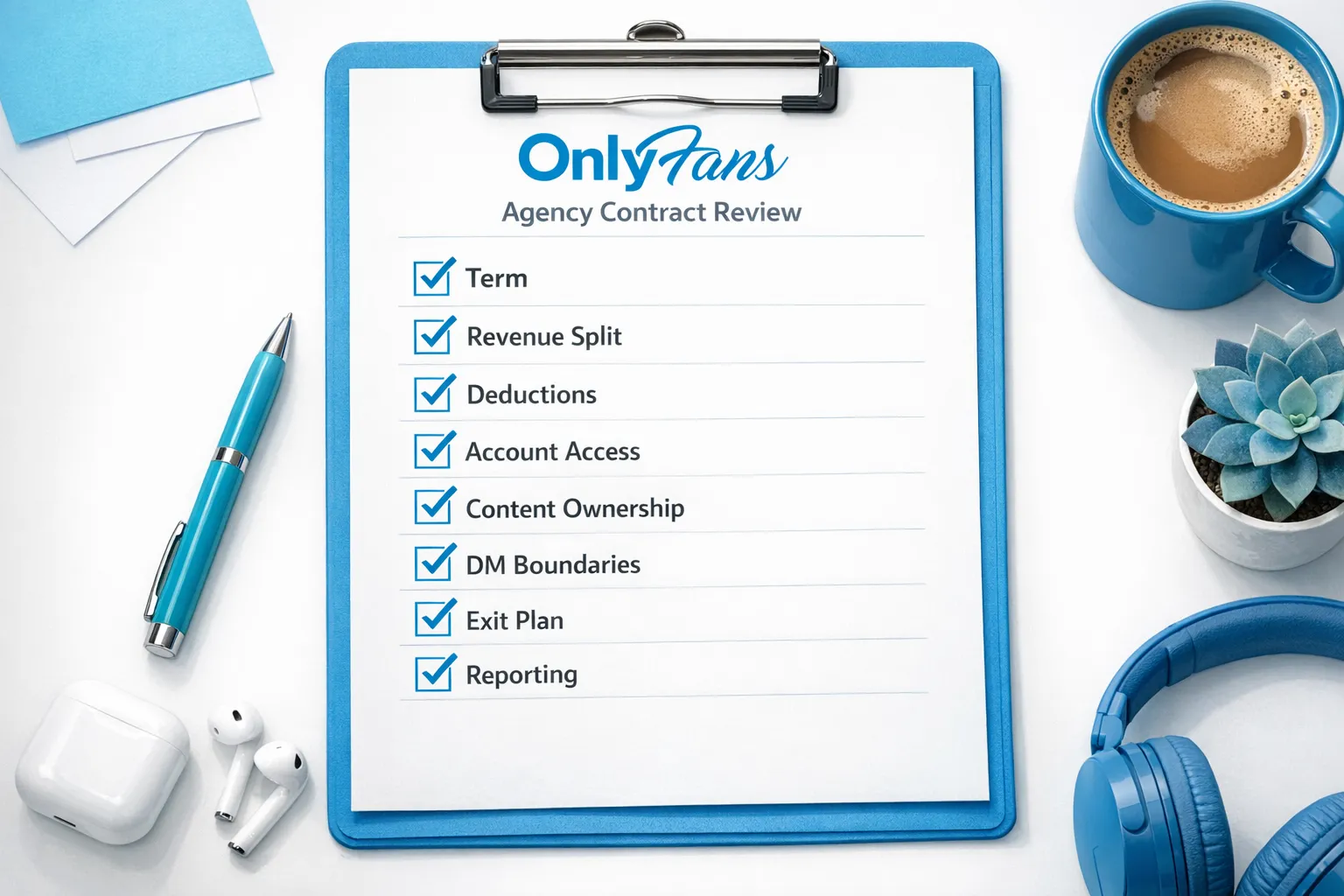
A creator-friendly contract scorecard (use this before you sign)
If you want a quick way to compare agencies, score the contract against these points.
| Area | Green light | Yellow light | Red flag |
|---|---|---|---|
| Term | Short trial or cancel-anytime | 3–6 months with clear exit | Long lock-in, no exit |
| Revenue | Clear base and deductions | Some deductions but documented | Vague “net” and uncapped costs |
| Access | You retain ownership + security plan | Shared access, unclear limits | Agency can change email/banking |
| Chatting | Transparent, consent-based, boundaries | अस्प vague who chats | Refuses to disclose or document |
| IP rights | You own content, limited marketing license | License continues briefly for transition | Agency owns content or perpetual rights |
| Reporting | Regular reporting, clear payout timing | Reporting only on request | No reporting obligation |
| Exit | Written handover steps | Handover promised but not defined | Threats, exit fees, withheld access |
If you hit even one red flag in access, IP ownership, or exit, slow down and renegotiate.
Common scam patterns hidden in “legal-sounding” contracts
Some agencies rely on contract complexity to create leverage later. Watch for:
- “Net revenue” manipulation: tools, promos, editors, ads deducted with no cap
- Account takeover leverage: they control email, 2FA, or payout details
- Perpetual licensing: they can use your content forever, even after you leave
- Performance promises inside the contract: “we will get you to X income” (this is a credibility problem, not a benefit)
- Aggressive penalties: huge fees for termination, even when they underperform
If you want a broader safety overview, you can also read Lookstars’ guidance on OnlyFans agency scams.
Questions to ask before signing (copy/paste)
Use these questions in a call and insist the answers match the written agreement:
- “Is your percentage based on gross or net, and what deductions are allowed?”
- “Who will access my OnlyFans login, and what can they change without my approval?”
- “Who chats in my DMs, and what is your escalation process for sensitive requests?”
- “What happens on day 1 if we terminate? Walk me through the handover.”
- “Do I keep full ownership of content and my brand assets, yes or no?”
- “What platforms do you manage, and what is excluded?”
- “What is the payout schedule and what reporting do I receive?”
If the agency gives great verbal answers but won’t add them to the contract, treat that as the real answer.
A simple contract addendum template (creator protections)
If you like an agency but the contract is missing basics, ask for a short addendum. Here are clauses creators often request in plain language.
Account ownership: Creator remains the sole owner of all platform accounts. Agency access is limited to operational needs.
Approval for sensitive changes: Agency must obtain written creator approval before changing email, password, payout settings, banking, or legal name details.
Content ownership: Creator owns all content. Agency receives a limited, revocable license to use content for marketing during the agreement only.
DM consent and boundaries: Agency may message fans on creator’s behalf only with creator’s consent, within documented boundaries. Creator may revise boundaries anytime.
Reporting: Agency provides regular performance reporting and a clear payout schedule as defined in the agreement.
Handover: Upon termination, agency returns access and materials within a defined timeframe, including credentials, tracking links, and content calendars.
A lawyer can convert these into proper legal wording for your jurisdiction, but even as a negotiation tool, this list is useful.
Who working with an agency is for (and who it’s not)
An agency is usually a good fit if
- You’re already earning and you’re bottlenecked by time, DMs, or marketing
- You want to scale with a team and a system, not just “work harder”
- You care about privacy, leak response, and operational discipline
It might not be the right move if
- You’re very early and still testing your niche and boundaries
- You’re uncomfortable with anyone else handling fan communication
- You’re not ready to produce consistent content (agencies can optimize, but they can’t create your content for you)
How Lookstars structures its creator partnership (what to confirm in writing)
If you’re comparing agencies, here are the terms Lookstars highlights publicly, and you should still confirm them in the agreement you sign:
- No upfront costs
- Flexible, cancel-anytime contracts
- Weekly payouts
- Support areas including marketing and fan growth, 24/7 fan chatting, posting management, content leak protection, and privacy features like country blocking and security setup
You can review the agency’s positioning and creator resources at Lookstars Agency.
Frequently Asked Questions
Do I need a lawyer to review an OnlyFans agency legal contract? A lawyer is not mandatory, but it’s strongly recommended for anything involving revenue share, IP rights, or account access. Even a one-hour review can prevent expensive mistakes.
Is “net revenue” always a scam? Not always. Net can be fair if deductions are clearly defined, capped, and documented. “Net” becomes dangerous when deductions are vague or controlled unilaterally.
Should an agency have my OnlyFans login? Many agencies require access to do day-to-day operations, but you should keep ownership and require written approval for sensitive changes (email, passwords, payout details). Security procedures should be spelled out.
Can an agency chat in my DMs legally? It depends on your agreement, disclosures, and compliance with platform policies. The important part is consent, boundaries, and clear rules on what can be promised or sold. When in doubt, verify in the platform’s current terms.
What’s the biggest contract red flag? Anything that blocks you from leaving safely, such as long lock-ins with no exit, withheld access, or agency ownership over your content or accounts.
Want a contract you can actually feel safe signing?
If you’re looking for an OnlyFans management agency with no upfront costs, weekly payouts, and flexible cancel-anytime contracts, you can apply to work with Lookstars.
Start here: Apply to Lookstars Agency


Ready to transform your career?
Join hundreds of creators already earning six figures with Lookstars Agency.
Share this article
Best OnlyFans Agency
Europe's Leading OnlyFans Management Agency.
100% Free Ebook
Get our guide and unlock the secrets to OnlyFans success.
100% Free Ebook
Get our guide and unlock the secrets to OnlyFans success.
Free Revenue Calculator & Profile Analyzer
Try them for freeContinue reading...
Am I Attractive Enough for an OnlyFans Agency? The Answer
Can You Ever Fully Delete Your OnlyFans Content? The Reality