Best Rated CRMs For Your OnlyFans Account: Which one to choose?
You don’t “need a CRM” when you’re starting on OnlyFans. You need content, traffic, and a simple system to answer DMs. . . But once you’re established (consi...
You don’t “need a CRM” when you’re starting on OnlyFans. You need content, traffic, and a simple system to answer DMs.
But once you’re established (consistent income, steady subs, a few high spenders, and multiple promo channels), the business changes. Your biggest leaks usually come from:
-
Losing track of warm leads who were going to sub “later”
-
Forgetting who bought what (and who hates what)
-
Treating whales like regular subscribers
-
Having multiple team members in DMs without a clean handoff or notes
-
Running promos and collaborations without a repeatable pipeline
A CRM is how you turn your account from “busy” into “scalable.” Not by spamming fans, but by organizing relationships, timing, and follow-ups.
What a CRM means for established OnlyFans creators
In normal business, a CRM tracks leads, deals, and customers.
For an established OnlyFans creator, a CRM is usually one of these (or a mix):
1) A lead CRM (off-platform): Track and follow up with people who engage on Instagram, X, Reddit, TikTok, or your email list.
2) A VIP CRM (on-platform relationship notes): Track your whales, custom buyers, and “high intent” chatters so your messaging stays personal and timely.
3) An ops CRM (team workflow): Assign tasks (custom orders, collabs, posting schedule, takedowns), store notes, and keep your team aligned.
Important: this should support your OnlyFans work, not violate platform rules. Policies can change, so avoid tools or workflows that scrape data, automate prohibited actions, or impersonate you in ways that break trust.
Decision framework: pick your “best CRM” based on your bottleneck
Most creators shop for a CRM the wrong way, they pick a popular tool, then try to force their workflow into it.
Use this decision framework instead.
Step 1: Identify your main constraint
If traffic is strong but conversions are messy: you need a lead pipeline (follow-ups, tagging, reminders).
If DMs convert but revenue per fan is flat: you need VIP tracking (preferences, last purchase, next offer).
If you’re growing but overwhelmed: you need team permissions, task assignment, and auditability.
Step 2: Decide what you are actually tracking
A CRM works best when you track just enough to act.
For most established creators, that means tracking:
-
Handle/username (platform + link to profile)
-
Stage (lead, warm, subbed, VIP, churn risk)
-
Last touch (date + where)
-
Next action (follow-up date, offer, custom reminder)
-
Notes (preferences, boundaries, what they bought)
Avoid tracking sensitive personal information you do not need.
Step 3: Match your tool to your workflow type
| Your primary need | “Best CRM type” for you | Why it fits | Biggest risk/tradeoff |
|---|---|---|---|
| Multi-platform lead follow-up | Sales CRM (pipeline-based) | Built for stages, reminders, accountability | Can feel too rigid for creator workflows |
| VIP notes + segmentation | Creator-focused CRM | Purpose-built for fan relationships and monetization | Can be less customizable than a blank-slate database |
| Team ops + content coordination | Workspace CRM (docs + tasks) | Great for SOPs, scripts, calendars | Weaker “pipeline” structure unless customized |
The best CRM options for established OnlyFans creators (and who each is for)
There is no single universal best CRM. The “best CRM to use for established OnlyFans creators” depends on whether you’re managing leads, VIP relationships, or a team.
Below are creator-relevant CRM options that tend to fit established accounts well.
Option 1: Infloww (best for creator teams who want a dedicated CRM)
Infloww is positioned as a creator-focused platform, which generally makes it a stronger fit than a generic sales CRM when your “customers” are subscribers and VIPs, not corporate leads.
Best for: established creators who want a purpose-built system for managing fan relationships and team workflows without forcing a traditional B2B pipeline.
Not ideal if: you want a completely blank-slate database you can customize endlessly.
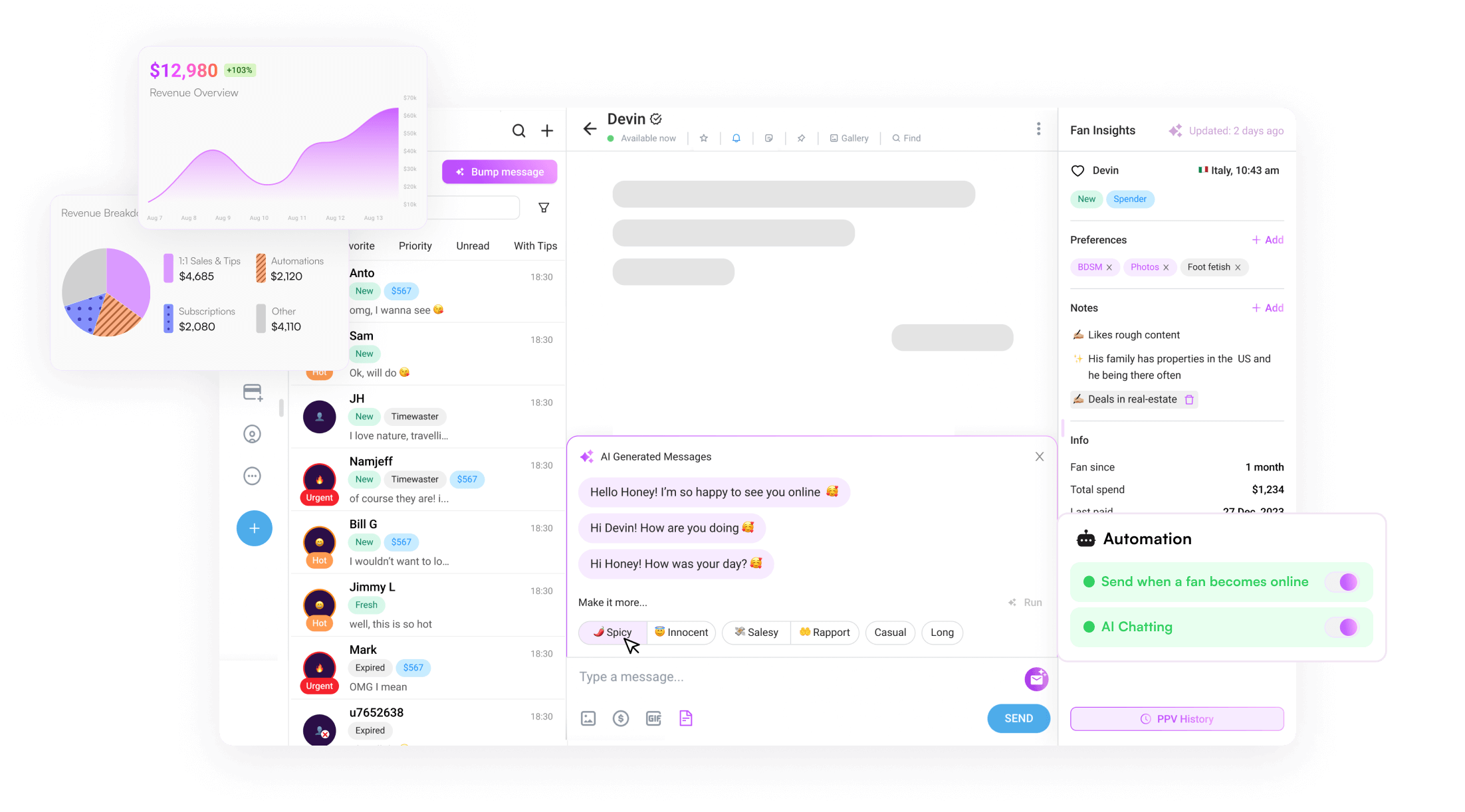
Option 2: OnlyMonster (best for creator CRM and analytics-style organization)
OnlyMonster is a creator-focused tool that many established creators look at when they want more structure around fans, segmentation, and day-to-day management.
Best for: creators who are past the “spreadsheet stage” and want a dedicated creator CRM environment rather than building everything from scratch.
Tradeoff: dedicated platforms can be less flexible than a DIY database if you have very custom processes.
Option 3: CreatorHero (best for managing relationships like a real customer base)
CreatorHero is built around the idea that creators need customer management, retention, and monetization infrastructure that resembles e-commerce or community businesses.
Best for: established creators treating their audience as a long-term customer base with repeatable offers and relationship history.
Tradeoff: you still need clean internal rules (tags, handoffs, notes), the tool will not fix messy habits.
Option 4: Supercreator (best for workflows and consistent fan follow-up)
Supercreator is commonly used to bring more consistency to fan conversations and revenue routines, especially when you have a lot happening daily.
Best for: creators who need speed and organization around messaging, follow-ups, and day-to-day execution.
Tradeoff: if your main problem is off-platform lead tracking (IG, X, Reddit), you may still need a separate system for that.
Option 5: FansMetric (best when you want CRM-style insight plus performance tracking)
FansMetric is often evaluated by creators who want clearer visibility into performance and fan behavior signals they can act on.
Best for: established creators who make decisions from metrics and want a tighter feedback loop between what’s happening in the account and what the team does next.
Tradeoff: metrics only matter if you turn them into a weekly operating rhythm (segmentation, follow-ups, and offer testing).
My practical recommendation (without hype)
If you’re an established OnlyFans creator and you want a creator-native CRM experience, start by shortlisting Infloww, OnlyMonster, CreatorHero, Supercreator, and FansMetric, then pick based on your bottleneck:
-
Pick the tool that makes VIP tracking and follow-ups easiest if your account already gets steady traffic.
-
Pick the tool that supports team handoffs and consistency if multiple people touch DMs.
-
Pick the tool that gives you clear performance visibility if you’re optimizing offers and retention.
Whatever you choose, keep your system simple enough that it gets used every day.
A 60-minute CRM setup that works for established creators
You do not need a complicated build. You need something your team will actually use.
Here’s a setup you can implement quickly in most CRM-style tools.
The core tables (keep it simple)
Create three tables (or three main objects/sections):
-
Contacts (leads, subscribers, VIPs, collab partners)
-
Interactions (important touches, purchases, notable conversations)
-
Offers (PPV themes, custom menu items, promos you run repeatedly)
This structure matters because it prevents “one giant sheet” from becoming unusable.
The fields that drive money (and save time)
In your Contacts table, track:
-
Status: Lead, Warm, Subbed, VIP, Churn risk, Do not contact
-
Platform: IG, X, Reddit, Email, Other
-
Source: Reel, Story reply, Reddit post, SFS, Collab, Referral
-
Last touch date
-
Next follow-up date
-
Spending tier (your internal label, not a promise)
-
Preferences and boundaries (short notes)
-
Assigned to (you, assistant, chatter)
In your Interactions table, log only what matters:
-
Date
-
Type: Follow-up, Sale, Custom request, Complaint, Refund issue, Boundary violation
-
Outcome: Bought, Didn’t buy, Requested later, Unsubbed, Warning issued
-
Notes (1 to 3 lines)
Views you should create on day one
These views make the CRM usable daily:
-
Today’s follow-ups (Next follow-up date = today)
-
VIP list (Status = VIP)
-
Warm leads (Status = Warm)
-
Churn risk (Status = Churn risk)
-
Unassigned (Assigned to is empty)
A simple tagging system that avoids cringe
Use tags that describe behavior, not fantasies. Examples:
-
“Custom buyer”
-
“Likes teasing”
-
“Short clips buyer”
-
“Chatty, low spender”
-
“Returns monthly”
The goal is better offers and better boundaries, not manipulation.
Templates: scripts and notes your CRM should store
A CRM is only valuable if it produces better conversations. Store templates so you do not rewrite the same messages under pressure.
Follow-up message template (warm lead)
Use this as a starting point and keep it in your CRM notes.
“Hey, you popped into my head. I posted a new set today that matches the vibe you liked (more teasing, less explicit). Want the link?”
Why it works: it’s specific, not desperate, and it asks permission.
VIP re-engagement template (lapsed high spender)
“I’m filming this week and I’m doing a small VIP drop for the people who usually spoil me. Want me to save you a spot before I lock it?”
Why it works: it signals exclusivity without making promises or over-discounting.
Boundary reinforcement note template (internal)
When something crosses a line, log it consistently:
“Boundary reminder sent. Request was outside my menu. Kept tone polite, offered alternatives.”
This protects you if you have a team and need continuity.
Security and privacy, don’t skip this part
A CRM centralizes sensitive business context. That’s good for scaling, but it increases the impact of a mistake.
-
Use unique passwords and enable 2FA where available.
-
Give team members the minimum access they need (especially for VIP notes).
-
Avoid storing personal identifiers you don’t need.
-
If you work with contractors, be clear about confidentiality expectations.
This is educational, not legal advice. Laws and platform policies can change, verify with official sources or a qualified professional.
When a CRM is not the right next step
A CRM will not fix weak fundamentals.
It’s probably not your priority if:
-
Your traffic is inconsistent and you do not know which platform actually converts
-
Your offers are unclear (no consistent PPV themes, no custom structure)
-
You do not have time to maintain the system at least weekly
In those cases, the better move is to simplify: fix your funnel, fix your offers, then add a CRM.
If you want the outcome but not the overhead
Some established creators choose a CRM because they’re trying to replace what a professional team would normally do: consistent follow-up, segmentation, scheduling, and operational discipline.
If what you really want is to focus on content while someone else handles marketing, fan engagement, privacy protection, and account management, that’s when a management partner can make sense. Lookstars (as a full-service OnlyFans management agency) describes support in areas like multi-platform marketing, 24/7 fan chatting, strategic posting management, and leak protection, with no upfront costs and flexible, cancel-anytime contracts. If you go that route, treat it like hiring any professional service: review terms carefully, ask who does what, and keep clear boundaries.
Bottom line
The best CRM to use for established OnlyFans creators is the one that matches your bottleneck:
-
Creator-focused CRM (like Infloww, OnlyMonster, CreatorHero, Supercreator, FansMetric) if you want systems designed around fans, VIPs, and monetization
-
Pipeline discipline if your main leak is missed follow-ups and inconsistent outreach
-
Team workflow clarity if multiple people touch chats and offers
Whatever you choose, keep it simple, build views you’ll use daily, and track only what helps you take the next best action.



Ready to transform your career?
Join hundreds of creators already earning six figures with Lookstars Agency.
Share this article
Best OnlyFans Agency
Europe's Leading OnlyFans Management Agency.
100% Free Ebook
Get our guide and unlock the secrets to OnlyFans success.
100% Free Ebook
Get our guide and unlock the secrets to OnlyFans success.
Free Revenue Calculator & Profile Analyzer
Try them for freeContinue reading...
Am I Attractive Enough for an OnlyFans Agency? The Answer

Can You Ever Fully Delete Your OnlyFans Content? The Reality